Showing posts with label attention. Show all posts

Wednesday, 30 March 2016

A Childhood Highlight


As many of you, I have a lot of childhood memories that make me smile.  Some of them exist in some form today, but very few are almost exactly like they were when we were growing up.  One of my favorite things while growing up was sitting in a doctor's office and looking through the Highlights Magazine.  It seemed to distract me from why I was in that doctor's office.  One of my absolute favorite parts of the magazine was the Hidden Pictures page.  I always felt like I had hit the jackpot when I got to look at it before someone else had circled all the hidden objects.

Fast forward a bunch of years and I am a grownup (for the most part) and I am asked by one of my goddaughters to support her magazine drive.  The first thing I ordered was the Highlights Magazine and have been getting it ever since for my daughter.  Quinn, who just turned 6, loves it and especially loves the Hidden Pictures page.  So a few weeks ago, when someone reached out to me and asked me to take a look at the new Hidden Pictures app, I jumped on it.  I am always looking for new apps, especially ones that are more appropriate for the older kids and this app definitely fits that description.  While they say that it's ideal for children ages 6-8, I think that it can be used with younger children who have strong visual skills, especially if an adult is playing it with them.


So far, I am a big fan of the Hidden Pictures app.  More importantly, the kids are really enjoying it. The pictures are colorful, bold and and great at encouraging conversation (for my speech therapy friends).  It's a great app to work on a variety of occupational therapy skills without the kids feeling like they are "working".  It's more of a game to find all the different objects hidden throughout the pictures and at the same time, the kids are working on improving visual skills (visual motor, visual perceptual and visual tracking).  If you want to try and work on graphomotor skills, you can have the kids use a stylus (I've been using the Cosmonaut lately and love it) when using the app.  You can also have the kids write out the objects on a piece of paper as they find them to work on improving their handwriting skills.  One more thing I like to do is after the kids complete a puzzle on the iPad, I have them do another one in this great Hidden Pictures puzzle book that I have.  There are a bunch of these workbooks out there but I like this one because they have a bunch of black and white pictures that you have to take a handful of stickers and put them on top of the object when they find them.  This adds a greater challenge for those kids who are doing really well with the app.

Unlike the older version of the app, the updated one acts more like a subscription plan.  You sign up and each month a new set of puzzle packs are available.  When you first download the app, there are already 60+ puzzles!  You unlock puzzles as you complete others and there are even special items in the puzzles that need to be collected.  One of the things I like is how there are different modes to choose from so you increase or decrease the level of difficulty/challenge for each kid you work with.  The three modes of play to choose from are:
Free Play-find the hidden objects in whichever order and in however long it takes you
Timed-find all the hidden objects before the timer runs out
Directed-you find the hidden objects in a the order in which they are listed

Oftentimes, parents ask me for app recommendations that would be good for the whole family.  If you are looking for an app that would be good to facilitate social skills and collaboration with a sibling or a friend, this is a great one.  While it can be played  individually, it's also perfect for working as a team to find all the hidden objects.  The kids can take turns finding something or you can have them find one and then they have to give a hint to their friend in order to find the object that they found.  This is great for working on improving language and organizational skills for those kids you know who struggle with these things.

As I have been getting to know the app, I have to admit that I have been sucked into playing  it all by myself for long periods of time.  It brings me back to my childhood in the best possible way.  It's been fun to play this at work and at home and makes me happy that something this simple still brings hours of entertainment to kids today.  If you are on the lookout for a new app for your little ones, I highly recommend Hidden Pictures.  It's not only something that will help strengthen your child's visual skills, it's an app that you won't mind playing with your children.  If you have any questions or want to know more about the Hidden Pictures app, I am always a click away and love hearing from you all!

Friday, 4 March 2016

Let's Play Princess Dress-up


Almost two years, I wrote a post about the Disney Magiclip Dolls that had become a favorite of mine at home and at work.  All this time later, they are still a huge hit amongst the kids I work with and my almost 6 year old daughter.  I'm happy to report that they have been used hundreds and hundreds of times (literally) and have stood up to the beating they have gotten.

A few weeks ago, while trying to kill some time between clients, I stopped into a little toy store in the city and discovered a new line of Disney Princess dolls by Hasbro that grabbed my attention.  They looked a lot like the Magiclip Dolls mentioned above, but as an OT, I noticed that there was a bit more to them that would help improve fine motor and manipulation skills.  These Disney Princess Little Kingdom dolls and accessories have become a favorite of my almost 6 year old daughter.  I'm sure I've mentioned it before here, while my daughter doesn't receive therapy, she does have some weakness in her hands and has a terrible pencil grip so I am always on the lookout for toys that will help her in that area. Since she adores all things princesses, I knew that these dolls would be perfect at hiding the fact that we were working on something that she doesn't like to work on with me.  These princesses are easy to play with and all the outfits are interchangeable amongst the dolls.  The skirts and the bottom of dresses kind of slip on and off and the tops get pushed into a little hole on their chests.

You can buy a big set of the dolls or get them individually.  Some of the sets come with pets or other kinds of things (Anna has a bike that my daughter loves!).  Additionally, you can buy castles or some kind of home for them which is great for working on play and language skills.  Each of the dolls are only 3" tall meaning they don't take up a lot of room!  Excellent news for parents and therapists on the go.  As already mentioned, the outfits and accessories for each of the dolls are interchangeable so each time kids play with them, they can make different outfits.  My daughter has loved swapping the outfits  or having them wear just part of the dress and making it into a skirt instead.  Once you get the hang of it, it becomes quite simple to remove and replace all the different parts of the outfits. My favorite part of the dolls is the itty bitty accessories that come with each of the sets that you can use to decorate the outfits.  This is the part that is great for working on improving fine motor and manipulation skills.  Remind kids to use their "pinchers" when picking up the small pieces and pushing them into place!

In addition to working on fine motor skills, the Disney Princess Little Kingdom work on improving bilateral coordination, eye-hand coordination, motor planning and executive functioning skills such as focus, attention and organizational skills.  The best part is that they are reasonably priced, especially when you think about the fact that you can use all the outfits and accessories with any doll.  I found a really good selection of them at State News on the Upper East Side of Manhattan but have also seen them at other local toy stores (I always like to support the mom and pop toy stores before going to Target or Amazon).

If you are on the lookout for an affordable, fun and portable toy (think restaurants, car/airplane rides, etc.), Disney Princess Little Kingdom dolls are the perfect thing.  If you have any questions, be sure to email me...I am only a click away and love hearing from you all!


Monday, 15 February 2016

It's Okay to Play With This Food!


It's been a while since I found a new game that I felt worth sharing.  To be honest, when I find something, it sticks around for a while.  For example, Tumbling Monkeys and Wok N' Roll have been part of my work routine for as long as I can remember.  When I read about how cold it was going to be this past weekend and that I would be entertaining not only my daughter but also another friend of hers, I decided it was time to add some new games to my daughter's collection. I went into my local toy store, Little Things, in Park Slope and could have gone a little crazy.  I was drawn to many of the educational games but knew that it wouldn't be well received by my daughter who is officially on winter break.  Instead, I went with a game that help work on improving her fine motor skills, particularly something that might help promote a better grip.  Yeti In My Spaghetti, by Play Monster (formerly known as Patch), was a HUGE hit with both my daughter and her friend.

I like when games are simple and easy for kids to play...that means that grownups don't have to struggle when reading the directions in order to figure out how to explain the game to said kids! How many of you have purchased a game like that and then never played it because you just couldn't figure it out??  Nothing frustrates me more!  Even better, there are no batteries required which means that this is a quiet game free of noise and lights!  The object of Yeti In My Spaghetti is quite simple:  place the 30 pieces of spaghetti over the bowl in a criss cross pattern and then place the Yeti on top of your pile.  Choose who is going to go first and begin pulling the spaghetti out from under the Yeti without letting him fall into the bowl.  You must be mindful, look at what you are doing and take your time when pulling the spaghetti pieces out because if the Yeti falls while you are pulling it out, the game is over.

Besides the fact that this game is fun, it is great for working on a ton of skills for your little friends (I can't help but let my occupational therapy brain go there).  Ideal for kids starting at age 4 (or a super patient 3 year old) and perfect for working on:
*facilitating a pincer grasp as you pull the spaghetti pieces out
*improving eye-hand coordination, visual motor and visual perceptual skills as you scan and plan what piece is best to take out from under the Yeti
*improve executive functioning skills, especially focus and attention and organizational skills
*improving social skills such as turn taking, good sportsmanship and teamwork (you can play in teams)

If you begin to get bored with the game, you can come up with some alternative ways to play it.  For example, add a dice to the game and have kids roll it and then take how ever many pieces of spaghetti that they roll.  If you really want to work on improving fine motor skills, have the kids remove the spaghetti pieces using a strawberry huller.  Do you have any other ways to vary how to play this game?

If you have kids or work with kids, I highly recommend this game.  Reasonably priced, easy to carry around and most importantly, fun to play.  Great for parents or therapists, even those that travel from home to home, since it is lightweight and doesn't require batteries.

If any of you have any great games that you have recently discovered or ones that are long time favorites, please share them with me and my my readers.  I am always a click away and love hearing from you all!

Friday, 23 October 2015

The Monster Mash!

Halloween is just around the corner and it's really beginning to feel a lot like it in the air.  All around New York City, decorations are up (I'm ignoring the fact that Christmas decorations are also popping up everywhere as well), kids are talking about trick-or-treating and their costumes and I'm going a little crazy with arts and crafts projects with my kids at work.  However, some of the kids I work with aren't into crafts but still want to get into the Halloween Spirit.

For those of you who read my blog, you will know that I am a big fan of using the iPad during my sessions.  When used in conjunction  with other therapeutic activities, it can be a highly motivating and educational tool.

Go Away, Big Green Monster-I've been a big fan of the Ed Emberley book of the same title for years.  I love the way the kids can interact with the story and how it helps some of the younger kids I work with learn about body parts.  The app brings the book to life and allows the kids to add and remove all the parts of the monster. Once he is put together, they can poke at him and see how this scary looking monster is nothing to be scared about.  I like that the kids can choose to read along with either a 4-year old narrator or hear the book be read by Ed Emberley himself. 
I like that you can add a hands on activity once you have finished playing with this app.  You can have all the pieces cut out of construction paper so you can have the kids make their very own Big Green Monster.  If you are working on teaching kids how to draw people, this can be a fun activity to reinforce where all the parts of the face go.
Sago, Sago Mini Monsters-Sago Sago has been a long time favorite of mine and children love all of the apps that they create. Each of these great apps are colorful and engaging and stimulate language, fine motor and visual motor/perceptual skills.  In Sago Min Monsters, children are able to create their own colorful monsters.  They can add details to make their monster their very own.  When they are all done creating them, they can interact with the monsters with pain, food and decorations. Kids think it's hilarious that they can feed the monsters and if they don't like the food, they will spit it out at them.  They can have them play with toys and instruments.  All of the interactive components make this a great app for working on following directions and language development.
You can add a fine-motor/craft component to this by cutting out similar monster parts and having the kids create a paper monster that they get to take home.
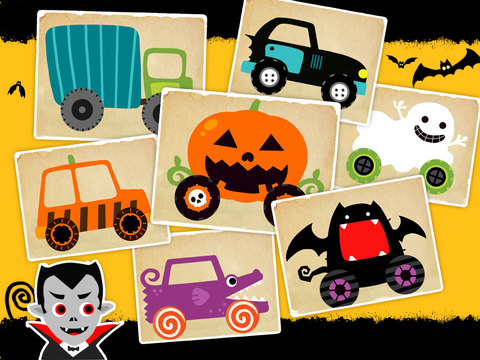
Labo Halloween Car-the kids I work with love the racing games so when I saw the Halloween Car app by Labo Lado, I had to have it.  I've used it with a few of the kids I work with and they really are loving it.  They get to choose from 12 different cars, several of them being Halloween themed (think bat, pumpkin and ghost).  They get to color it any way they want, add wheels and then add details and a character to make their car their very own.  Once they have completed designing it, they get to take it on a ride through different spooky racing routes.  
This app is great for working on improving graphomotor skills, encouraging creativity and visual motor/perceptual skills.  Also great for working on executive functioning skills, such as focus and attention and organizational skills.   
Stella and Sam Halloween Band-I've been a longtime fan of all things Stella and Sam by Zinc Roe Design since they are so interactive and work on so many occupational therapy goals.  If you haven't checked out their other apps, do yourself a favor and do it!  In this Halloween themed app, you get to join Stella and Sam in their band!  There are 6 different instruments to play.  You can change the sounds by moving the band members side to side or up and down.  If you look carefully, you will see bats, spiders and other characters floating around that you can interact with.  Great for preschoolers or young school-age children.  You can work on color recognition by having the kids hit the different colors when you ask them to.  As they get more familiar and comfortable with their colors, you can make this more complex by having them follow sequences.  For some kids, you might want to make them remember the order just by telling them and for others you may want to put out a visual for them to follow.  Kids will creating their own music while learning at the same time.  
Spooky Letters-I have a ton of great handwriting apps, but thought it would be fun to spice things up with this Halloween themed writing app by MadeByEducators.  In this app, children can practice writing upper and lower case letters, cursive letters, shapes/pictures and words.  What I really love about this particular handwriting app is that there is a big focus on phonics.  After practicing writing each letter, the kids then have to put letters in order for a word that starts with that letter or put together a simple puzzle that reveals what monster is hiding in the box.  For example, after you write the letter "K", a jumbled up word (key) comes up and they have to put them in order.  During the whole thing, the kids are hearing the letters being sounded out which is great for those who are struggling with learning how to read.
**one thing I noticed is that some of the letters that we typically start at the top (M and N for example), actually start at the bottom.  Could be confusing for some kids but there are a lot more positive things about this app that make it a good one to add to your handwriting app choices.

If you are concerned about using an iPad during therapy, keep in mind that there are a ton of ways to make it more therapeutic.  I also can't Here are a few examples of things you can do to make using the iPad more meaningful, whether it be at home or during your therapy sessions:
*use a stylus-many of the apps can be done using a stylus.  So even though the kids are absorbed in the app, they are working on developing a proper grasp.
*many of the kids I work with need to work on increasing their overall body strength, particularly upper body and neck/head.  Have them go on the net swing and play the apps.  
*if you work with groups of kids, almost any of these apps can be good for a small group setting.  They will have to compromise about colors for their cars, what to feed the monster, take turns playing instruments, etc.. There are a lot of great social opportunities available when using the iPad in a therapeutic setting. 

I would love to hear if any of you have some great Halloween or fall-themed apps that I should check out.  I like to take advantage of holidays and mix things up during my sessions.  Between the great arts and crafts activities, baking activities and the iPad apps, I have been rejuvenated the last couple of weeks during my sessions.  The kids are also having a great time and excited for new things at the gym.  So if you have any fun things to suggest to me or my readers, please share them!  I am always a click away and love hearing from you all!


Friday, 16 October 2015

Let's Build These Cars and Take Them For a Test Drive

As the holiday season approaches, I've been keeping my eyes peeled for hot toys and games to add to this year's gift guide.  Parent are already asking me what they can get their children and what they can suggest that others get them.  While parents want to get things that their kids want and will like, they also interested in getting things that will help them reach some of their therapeutic goals.

I've always been a fan of Legos and have quite the collection that I use at home and at work.  For some of the older kids on my caseload, working with Legos can be motivating and get them to work on a number of skills.  They are great for working on increasing hand strength and improving manipulation skills, which  is important for handwriting, cutting and all kinds of other academic activities.  It helps with executive functioning skills, especially improving organization, problem solving and focus and attention.  At the end, the kids have a final product that they have built themselves and there is a tremendous amount of pride.

Many of the kids I work with are under the age of 5 and have significantly decreased grasp strength and poor fine motor skills.  Therefore, regular Lego sets are typically not appropriate for them and end up causing more harm and frustration than good.  In the past few years, Lego has expanded their Duplo products and there are some pretty amazing ones to choose from.  The other day, I was looking around and stumbled upon the Creative Cars set.  First of all, I was impressed with the affordable price tag of $20.  The set comes with 40 different colored blocks in a variety of shapes, including windows, sirens and other truck parts.  With those 40 Duplo blocks, you can create tons of different cars and trucks, including a dump truck, a police car or a tow truck.  The set comes with a poster that shows you all the different things you can make.  The best part is that the pictures are big and make it very easy to follow the directions.  Depending on the child you are working with, you can make something small and simple or bigger and more complicated.  I like that most of the cars and trucks use less than 10 pieces (most of them are closer to 5 or 6 blocks) so they can complete them in a short amount of time.  After the kids have built all the different vehicles, you can ask them to try and create their own.  If you have kids who need to work on being more creative, you can put a handful of pieces in front of them and have them come up with their own creation.  

Some of the other occupational therapy skills that can be worked on using the Duplo Creative Cars set are:
Improve Grasp Strength-as previously mentioned, all Legos, no matter the size, are great for working on increasing grasp strength and making those little muscles in the hands stronger.  Many of the kids I work with tend to avoid working with manipulative kinds of toys because they are hard for them so it's important that I find things that are interesting and exciting to them.  I've only been using these for a couple of days, but I can tell you that the kids are loving them and asking to build more and more cars instead of giving up after just one.  

Improve Bilateral Coordination Skills-building with Duplos are great for working on bilateral coordination/using two hands together during activities.  For so many of my little kiddos at work, this is a difficult thing for them.  I spend a lot of my time telling kids to use both hands.  Even with blocks and other manipulative toys, I watch kids not use two hands and they get frustrated because the blocks aren't sticking together.  Bilateral coordination is important for so many things, including handwriting, cutting and other academic activities.  It's important to find motivating ways to work on this skill, and this car set is proving to be very motivating!
Improve Visual Motor/Perceptual Skills-as I mentioned earlier in this post, the set comes with a poster with pictures of all the different cars and trucks that you use as a reference when building with the blocks.  This is great for kids to work on improving their visual skills, such as visual tracking and visual perceptual skills.  Kids have to be able to look through and scan the big pile of blocks to find what they need to build the car or truck of their choice.  Once they have all their pieces gathered, they need to be able to be able to look at the diagram and figure out what pieces go where.  It can be tricky sometimes because some of the pieces look really similar so I have the kids double check their pieces before they begin building.
Improve Executive Functioning Skills-there are so many executive functioning skills that can be worked on when building with this Duplo set.  First of all, being able to follow the directions and maintain their attention is very important in order for children to be successful when building their cars and trucks.  They also need to be able to sort and organize their blocks before building.  Sometimes kids can frustrated when things aren't easy and give up easily.  Being able to ask for help instead of giving up and getting upset is a really important skill that can be worked on as well.  
Improve Social Skills-these cars are great for working on improving social skills with younger children.  I had a small group of 3 boys playing with them yesterday and it was fascinating to watch them work together to build cars and then play with them.  The great thing about this set is in addition to being able to build cars and trucks, you can build a gas station so you can expand play skills at the same time.  In my social skills group, I had the kids build a garage using Magna-Tiles which they thought was really fun.  Using the Creative Car set with a group of kids will help them work on sharing, compromise and working together to build something.  This can be a difficult thing for kids and is something that's important to work on so they can be socially successful in a classroom setting later on.

While I have only had this Creative Cars set for a few days, it has been a popular activity amongst all the kids on my caseload.  When I told one mom that her son had played with the Duplo blocks for almost 10 minutes, she didn't believe me.  "My kid doesn't play with Legos, Meghan." I think that the building of vehicles and then being able to play with them are highly motivating for the kids.  If you wanted to add another level of play to this, you could get this Road PlayTape and have the kids set up a course for their vehicles to drive along.  There are so many things that you can do with the vehicles once they are built.  As I mentioned earlier, you don't have to just make the vehicles that they have pictured on the poster.  Sometimes kids need to be able to think outside of the box and become more creative in their play.  Have them build vehicles and tell stories about them.  Have them give the vehicle a name, a magic trick it can do or a place they are going to go on some kind of magical adventure.  Being able to be imaginative and tell stories is a really difficult but important skill for kids, even preschoolers.

Whether you use these with an individual child or a group of children, there is so much that you can do with the Creative Car set by Duplo.  While they are having fun, you can be happy knowing that they are working on developing a ton of skills that will help them become stronger and more confident little people!

Be sure to check out your local toy stores (I found mine at Mary Arnold Toys on the Upper East Side of Manhattan) before going to Amazon or the other big box stores.

If you have any questions, I am only a click away and love hearing from you all!


Friday, 25 September 2015

One Bead at a Time

When my daughter was coming up with her list for Santa Claus last year, she kept this arts and crafts kit she had seen at Toys R Us.  She couldn't tell me much about it but said they had all kinds of beads that you could spray together to make animals and other things.  She was so excited but I had no idea what she was talking about.  When she unwrapped her Beados machine from her babysitter, I though she might explode with happiness.  I, on the other hand, was scared at first and just imaged these little beads spilling and going all over the place.  I also didn't see how Quinn would be able to complete this particular art activity without me helping her for almost the whole thing.  There were some tears (by both of us at one point), but once we successfully finished our first Beado project, we felt really good and excited to make more.  As an occupational therapist, I couldn't help but thinking about how great this particular product would be for some of the kids I work with.

For those of you who haven't heard of them, Beados and Aquabeads are small, colorful beads that stick together when sprayed with water.  They are two different brands of a pretty similar product but do exactly the same thing.  Each kit comes with several templates, a work palette, hundreds of different colored beads and a pen/wand that you use to put the beads into place.  My daughter has this work station kind of thing that comes with a base, a storage spot on the top for all the beads and a special pen that helps put the colored beads into the correct place.  There are tons of different sets out there including magical creatures, foods and sea creatures.  I am a big fan of the Alpha Set by Aquabeads which I have used at work with a bunch of my kids already.  My goal is to have my kids help me make the whole alphabet and then attach magnets or velcro to them and have kids work on letter recognition and practicing spelling words and other kinds of fun alphabet games.  

Total disclosure because it wouldn't be cool of me to not share some important facts about this product.   First of all, there are a lot of tiny pieces...lots and lots of little water beads that you need in order to complete all the patterns.  If they spill, you will be stepping on them for days to come. I highly recommend that you do this at a table with good lighting.  If you have younger children, it might be best to do this with your older kids while they are doing something else because your help will likely be needed.  Secondly, you (as a parent) need to have a lot of patience as your child is completing them.  Your kid will end up getting frustrated or annoyed because it is highly likely that they will end up messing up their design before it's completed.  It may take several attempts before you figure out the best way to complete this activity.  

With all those warnings above, there are a lot more benefits to using Aquabeads or Beados and I have been using them a ton with the older kids on my caseload.  I have found that motivating my older kids to work on things that challenge them becomes increasingly more difficult and they become very good at avoiding them.  Another thing that I have found is that if there is some kind of really cool thing to take home with them and the end of a session, it makes them more excited to work harder and work through those challenges.
Here are a few occupational therapy skills that can be worked on when using Aquabeads or Beados:
Improve Fine Motor Skills-as soon as I started playing with Aquabeads and Beados with my daughter, I thought about how great it would be for those kids who need to work on improving their hand skills.  While they are definitely tricky, they are great for working on developing fine motor skills such as grasping skills.  You can use the special pen that it comes with (it's about the size of a regular pen or pencil) and encourage the children to hold it in a tripod grasp.  If you want to really challenge a kid, you can have them use their pincer grasp to pick up the small beads and place them into the palette.  For an even bigger challenge, have them pick up a few at a time and make them hold them in their palm and translate them to their fingertips as they place them in the palette.  
Improve Visual Skills-there are so many different visual skills that can be worked on while playing with Aquabeads and Beados.  First of all, you have to be able to visually track between the beads and the palette with the template under it.  You need to be able to recognize what color bead you need (some of the colors are similar) and place it where it goes.  This is also a great way to work on improving visual motor integration/eye-hand coordination.  
Improve Executive Functioning Skills-finding fun and motivating activities for my older kids can be challenging, especially for those who present with difficulties with executive functioning skills.  Aquabeads and Beados are great for working on so many of the key executive functioning skills.  For example, if you have a child who has a difficult time with planning and prioritizing, you can talk to them about how they want to complete their picture.  Do they want to place the beads into the palette row by row or complete one color at a time?  Do they want to place the beads in from top to bottom or from left to right?  Make the child come up with a game plan and then have them evaluate how they did once they complete it.  Another great executive functioning skill that can be worked on is practicing how to control impulses.  So many of the kids I work with move quickly, not thinking about how those actions will effect his/her work.  Kids will learn quickly that if they move too fast, they will mess up their work and have to start over again.  When I do this with kids, I talk to them about how important it is to keep their bodies calm and in check.  These are also great for working on improving a child's attention and focus.  Depending on a child's attention span, I give them different templates to choose from.  I want them to be able to complete the project in one sitting and if it is too big, some kids won't have the attention or ability to sit still long enough for them to be successful.  I always want to set my kids up to be successful, especially with new activities, so making sure we set reasonable goals makes it more likely they will be successful.  
Improve Confidence and Self Esteem-while it is likely that your child may become frustrated during this activity, it is also highly likely that they will be so proud of their completed project that it will make them forget about how frustrated they got.  I actually just did this the other day with a little girl who had tried doing it a few days before.  Her mother said that she got so frustrated when she messed up that she ended up in tears and threw away the project.  We ended up talking about what had happened the other day and she decided she really wanted to try it and wouldn't get upset.  We came up with a plan, talked about how she needed to keep her body calm and not move too quickly and that if anything got messed up, we would fix it and move on.  We worked for a long time and when she finished it, she literally squealed with joy over her completed Shopkin Beado.  She also couldn't stop talking about how she didn't get frustrated and that she kept her body calm so it didn't get messed up while she was working on it.  
Improve Social Skills-this is one of those activities that can be done independently or with a group.  If you have a couple of super-crafty kids that you work with, you can easily have them complete a project together.  With my daughter and her friends, they take turns placing the beads into place.  They have to compromise who will go first, how many beads they get to put in, etc..  I love the language it encourages, especially if you make one of the sets with characters (we are a big fan of the ShopkinsFrozen and Hello Kitty sets).   Once they are completed, they can act out scenes and make up stories together.

Like I have mentioned, Aquabeads and Beados are not for everyone and I am very careful about who I would give them as a gift to.  If you are a crafty and patient person and love spending time with your kids doing these kinds of activities, then I highly recommend them.  If you have a child who has fine motor difficulties and resists working with you at home, then this could be a fun way to get them to do work without them realizing that they are working!  I'll admit, I find myself totally wrapped up in an Aquabeads or Beados project with my daughter and love seeing the beads come together to make something fun.

Wednesday, 2 September 2015

What's On My iPad

I had grand plans this summer to do wonderful things with my blog and write at least weekly...maybe even more.  Well, the beach and my kid called and I hardly wrote at all.  Now I am playing catch up because this time next week, I'll be in that back to school panic mode and worry I won't have time to write.

I spend a lot of my summer trying to figure out ways to get things new and fresh for the new school year.  While there are a ton of apps on my iPad that I've had for years and that the kids never tire of, I like to add new ones.  In this post, I will share the apps that are the most popular with the kids in my life right now.  Some may have been written about before and others will be new.  The common factor is that they are fun, motivating and worth every penny (for those that you have to purchase).

I know that using an iPad in therapy is not for everyone and I certainly don't use as my sole means of
teaching a child a skill.  The truth is that using an iPad and finding good apps can be really motivating, especially to children who are struggling with skills.  I have found that an iPad is exciting for them, particularly for those children who don't have access to one at home.  Another great thing about it is that it is easily used in conjunction with other activities that address similar goals.  For example, how many of you have a kid or work with a kid who will avoid handwriting at all costs?  I have had so much more success with getting a kid to pick up a pencil and copy a shape or write a letter or number after they have practiced it on the iPad.  There are also a lot of ways to make using an iPad more therapeutic:
*use a stylus whenever you can while using the iPad, especially if you have a child who needs to work on improving their grip on writing instruments.  My favorites are the the iCreate Crayon stylus, the Kikkerland Retro Stylus and the Paper Mate 2 in 1 Stylus pen.
*whenever possible, I have my kids lie prone on the net swing or over a bolster when using the iPad.  This works on improving upper body strength but they are often so focused on what's on the screen that they aren't focusing on being or getting tired.
*when appropriate, try and have kids work together to play the iPad.  People don't think something like an iPad can encourage social skills, but I have found that it is a wonderful tool for that.  Turn taking, problem solving for puzzle games and increasing pragmatic language are all things that can be worked on using an iPad
*bring parents in and show them the apps you are using with their child so they can do them with them at home.  Parents are always asking me for things that they can do that isn't really work.  I know from trying to "work" with my own child, that if it looks like work to her, she won't do it for me.  Making sure it is fun goes a long way and parents feel good that they are having quality time with their children while working on important skills.

Here are my iPad choices for right now.  Each of them has been kid tested and therapist approved!  

Star Gurus-I'm always looking for connect-the-dot like apps but most of them are boring and the kids tire of them quickly.  Additionally, you get a couple of puzzles and then have to keep paying extra money in order to add more to your collection.  A couple of weeks ago, I stumbled upon Star Gurus by Colto, a wonderful a creative studio dedicated to creating educational apps that will "make your kids smile", and was so excited by how captivating and motivating they were.  In addition to teaching your kids to count, it works on improving eye-hand coordination, visual tracking and several other occupational therapy skills.  One of the things I like about this particular connect-the-dot app is that you also have the option of counting by 2s or 10s which makes this more appropriate for some of the older kids on your caseload.  I have also found that the kids I work with are super motivated about the final product of connecting the dots....once all the stars are connected, they form a constellation.  Very motivating and exciting for kids, especially those who are interested in stars!

Shape Gurus-another great app by Colto, Shape Gurus is a fun and motivating way to learn about shapes, colors and early geometry skills (I wish I  had something like this for myself when I was growing up!).  This app is appropriate for children as young as 2 years old, but the older preschoolers and young school age kids on my caseload are loving it.  Shape Gurus stimulates creative problem solving, sequencing, visual motor and visual perceptual skills and many more.  I like how each puzzle moves into the next one allowing the parent or therapist to work on building language skills at the same time.  At the same time, it can work on increasing attention span.  Since each puzzle moves into the next one, the kids are engaged and not wanting to stop playing the game.  Some of my kids with the shortest of attention spans easily spent the 15 minutes it took to complete the whole game without any encouragement from me.   

Lazoo Art Box-I wrote about this one in great detail here a few weeks ago, but didn't want to leave it off this list of my favorites.  Lazoo has been a long time favorite of mine and I discovered their apps because of the amazing activity books that they have developed over the years.  They have taken the magic and uniqueness of their books and put them into a truly dynamic and motivating app that encourages, motivates and gets kids excited about art.  The best part for me is that while there are clear ideas and suggestions about what to do (i.e. draw something coming out of an elephant's trunk, put swirly wool on a lamb or color in an airplane before it takes flight), they leave plenty of room for a child to think outside of the box and be as creative as they want to.  Lazoo Art Box is a great way to work on improving graphomotor skills such as 

LetterSchool-as for as handwriting apps go, LetterSchool continues to be my go to and the first one I recommend to parents who are looking for a fun way to practice letters with their children.  Whether you want to begin working on teaching children how to write their letters or if you want to review what they already know, this is the best app out there.  It comes with three options:  uppercase, lowercase and numbers.  There are two levels of play for lots of practice.  For each letter and number, you work through 3 games (tap, trace and write) in order to earn stars.  Once you have completed both the silver and gold levels of play, you can then unlock the opportunity to do free-form writing.   Don't forget to use your stylus when using this app!

Winky Think-Spinlight Studio is a series of logic puzzles that will help your kids develop problem solving and fine motor skills.  Due to the puzzles getting increasingly more challenging, this app is appropriate for preschoolers and school age children.  To quote my 5 year old daughter, "This started really easy but it's getting more difficult!"  However, it doesn't stop her from doing the harder puzzles and feeling more proud of herself when she gets the puzzles on her own.  I've tested it out a few times and must admit that I ended up getting sucked into it as well!  With each puzzle, kids learn a new tool that will help them solve puzzles that will show up later in the game.  One of the things I like most about this is that there is no timer and the children are given as much time as they need in order to solve each puzzle.  Often times these kind of math and reasoning games are timed and end up causing the kids I work with to get nervous and have increased difficulty in completing it.  Another great app for older kids.

Avokiddo Think Rolls/Think Rolls 2-another one of those apps that I have written about in great detail before but can't be left off this list.  Most of the apps I have are geared towards the preschool or early school age kids.  Finding apps that will keep the attention of the older kids on my caseload is more difficult and when I find one, I am super happy.  You can read all about all of the Avokiddo apps in this post here but Think Rolls and Think Rolls 2 is awesome for the older kids on my caseload.  Kids choose a character and have to move them through a series of obstacles and mazes.  Each chapter introduces a new object with a unique physical property that kids will have to manipulate and experiment with in order to get through each puzzle.  These games are great for working on focus, attentional and problem solving skills.  I sometimes have kids play this game together in order to work on improving social skills.  It's a great app for kids to problem solve and work together to solve the puzzles...especially as it gets more and more challenging.

So, these are the apps that are getting the most screen time on my iPad.  I love that almost all of them are appropriate for a wide range of ages and that they are interesting and challenging enough that parents won't mind playing them with their kids.  As a new school year begins and you might be looking for educational but fun apps for your kids, I recommend any or all of these 6 apps.  I know that we tend to try and decrease the amount of screen time our kids have during the school year, but rest assured that any of these will help with learning and building important skills that will carryover into what they are focusing on in school.

Do you have any great apps you discovered this summer?  Now that my own child is going into school, finding wonderful apps is even more important for me.  Send along any suggestions, questions or thoughts to me.  I am only a click away and love hearing from each and every one of you!

Saturday, 25 July 2015

Finger Looming Good

Two summers ago, the must have toy for everyone was The Rainbow Loom.  It would sell out in stores before they even had a chance to placed on the shelves.  You would go to the beach or the pool and see gaggles of kids gathered around their looms chatting, sharing their ideas and bracelets.  It was such a phenomenon.  I wrote about it in depth in this post here (which happens to be the most viewed post of mine) which still gets hits even two years later.  While Rainbow Loom isn't as popular as it was two summers ago, I find that kids still like making them, particularly my 6-8 year old kids.

The other day, I had time to kill between clients and walked into Learning Express and saw a handful of new items. One of the things that caught my eye was the Finger Loom.  Made by the creators of the original Rainbow Loom, this kit requires no hook and bracelets are made using just your fingers.  Even though I knew how great it would be for me to have in my bag of tricks at work, I immediately thought of my 5 year old daughter.  When the Rainbow Loom craze was going on, she was a sassy 3 year old who wanted to do everything her 5 and 7 year old cousins were doing.  She was so frustrated and sad when she couldn't do it but has been asking to learn ever since.  We have tried the bigger loom, but she would give up pretty quickly.  Yesterday, I was spending the day at the beach with just her and figured this would be a fun thing to bring out and show her.  At first, she wanted me to do it for her, but I insisted she at least give it a try.  When she first started, I agreed that we could take turns making the bracelet but after just a couple of times, she took the loom and the bands and took over the bracelet making.

There are a lot of things I like about this particular loom, especially for younger kids.  While I take out the original loom quite a bit at work, I find that for my kids who lack coordination, the big size can be awkward for them to hold onto and they require more help.  I also love that this doesn't require a hook to complete the bracelet.  This allows kids to get the hang of the process of making the bracelet without worrying about manipulating the hook, especially if they are holding it the right way.  Since there are only 4 pegs, there is less for them to be distracted by and they can keep their focus on just the bands and not the rest of the loom.  For so many of my kids, this will be a great way to introduce them to Rainbow Loom bracelet making and get them motivated to be challenged and try the bigger ones once they have master the Finger Loom.

Like the original Rainbow Loom, the Finger Loom has a tremendous amount of therapeutic benefits. Some of the skills that can be worked on using the Finger Loom are:
Improve Fine Motor Skills-this bracelet maker might be small, but it it is a great way to work on improving grasping skills and in-hand manipulation skills.  From picking the bands out of the pile, to placing them on the loom to using your fingers to pull the bands off the pegs, there an endless number of skills that can be addressed.  The best part is that the kids are so engaged and motivated by the bracelet making, that they don't realize that they are actually doing work!
Improve Bilateral Coordination Skills-this is a great tool to work on improving bilateral coordination skills (the use of two hands in a coordinated manner). It is nearly impossible to be successful making a bracelet without using both hands.  My 5 year old daughter tried it and realized quickly that she needed both hands because I wasn't going to hold onto the loom for her while she made her bracelet.  Once I prompted her to hold the loom with her non-dominant hand and to do all the fine motor work with her dominant hand, she become more independent and successful.
Improve Focus and Attention/Improve Executive Functioning Skills-like the original loom, the Finger Loom is great for working on building executive functioning skills.  If you want to work on working memory, you can give a child the directions and have them either write them down or repeat them back to you or another friend.  If you want to work on organizational skills, you can have the child you are working with pick out a pattern that they must follow and get out all of the bands that they will need to complete the bracelet out before beginning.  I like to have older kids work on these more challenging activities in a room with some distractions present in order to work on being able to build their focus and ability to attend and complete tasks in a more typical environment.  It seems silly, but if they can do something like making a bracelet with distractions present, they will be more likely to complete classroom assignments.

As we head into the end of July, I know many families are getting ready to go on family vacations and are always looking for things to keep their kids occupied on long drives, dinners out or time at the beach or by the pool.  The Finger Loom is a perfect thing to pack as it is light, small and takes up very little room in a bag.  It is also very reasonably priced (you can get a party pack of 9 looms for $16 on Amazon!) so you can pick one up for all the kids and/or guests who might enjoy them.  So in addition to being a great occupational therapy tool, it can be an activity that can keep a group of kids engaged with each other and develop social skills (sharing the bands, making bracelets for each other, etc.).

Happy Looming!

Wednesday, 22 July 2015

Let's Get Cooking!

It's totally crazy to think about how quickly this summer is going.  I don't know about you, but even though we are having a lot of fun and doing lots of things with our own daughter, my husband and I are sometimes trying to figure out what to do with her.  We are getting to that point, especially these last few days, that it's so hot out that we don't even really have the motivation to go outside.  So even though there are several weeks left of summer, it is now it is time to get creative and keep us all from going to stir crazy.

One thing that brings me more joy than pretty much anything is baking.  It is something that connects me to my father and acts as my personal therapy.  As soon was Quinn was old enough, I started having her bake with me.  As a matter of fact, one of my favorite gifts for her was her first apron (thank you Carrie Cook!  Quinn still wears it when baking all these years later).  It started off simple and I would have her pour all the ingredients in for me.  As she got older and could be more involved, I'd let her do more.  The day I let her crack her own eggs was a pretty exciting day for her.  Baking with Quinn has been something that has not only been something we could do together to bond over, but has been a fun way to teach her new things.

Cooking and baking with your kids can be a wonderful activity, especially in air conditioning on these super hot days.  When parents are asking me for things to do over the summer to keep their kids up to speed with their occupational therapy goals, baking is one of the first things I suggest.  Not only is it fun, it can be tremendously therapeutic. Additionally, introducing kids to cooking/baking early on in life makes them more likely to take risks when eating and try new foods.  There are also a lot of ways to sneak in opportunities for learning when baking.  For example, if your child is working on learning their letters and numbers, they can make cookies using alphabet or number cookie cutters. If they need to work on building up strength, you can do it while stirring ingredients.

**before I begin the next half of my post, I am going to admit I am much more of a baker than a cooker.  So going forward, when I say baking, it represents both baking AND cooking***

Some of the therapeutic benefits of baking with your kids are:
Improve Upper Body and Hand Strength-baking is a great way to work on this skill in a fun and sneaky way.  Stirring the ingredients, especially as they start blending all together, can become increasingly difficult and require a lot of strength and endurance.  When baking for your family, I suggest that parents let their kids roll up their sleeves and mix with their hands instead of a spoon or a spatula....this really helps with building up the strength in those small muscles of the hands.
Improve Bilateral Coordination-baking is a great way to work on improving bilateral coordination because there are so many parts of this activity that require the use of two hands.  For example, when pouring the ingredients you need one hand to hold the measuring cup or spoon and the other pours the ingredients.  When mixing the ingredients together, it's essential that you hold the you hold the spoon or spatula with one hand and keep the bowl stable with the other one.  How about cracking an egg?  You need to hold the egg with one hand and keep the cup or bowl still with the other.
Improve Fine Motor Skills-do you have kids who need to work on improving cutting, grasping and other fine motor skills?  Baking is a great way to do that in a really fun way.  Need to work on cutting?  How about getting your kids to cut open the bag of chocolate chips?  If you have a ton of patience and time, you can use a pair of Zoo Sticks to put some of the smaller ingredients in (chocolate chips, pieces of fruit, etc.).  Even the simple task of pulling the paper off the butter is a great fine motor activity.
Improve Visual Motor/Visual Perceptual Skills-baking is a great way to work on improving visual skills.  When you are following a recipe, you have to be able to visually track between the recipe and the ingredients.  You need to be able to pour ingredients into a measuring cup or spoon and be able stop pouring them when they hit the line.
Improve Executive Functioning Skills-what I love about baking is that it is a great activity to work on improving higher level skills for older children.  Baking requires an incredible amount of focus and attention.  It requires one to be able to organize their ingredients, sequence and follow directions.  If you one doesn't (and I have lots of experience here) follow directions and focus carefully, you can end up with a mess of a project.  Baking is a great activity for older kids who need to work on improving their executive functioning skills and the best part is that much of the work can be hidden.
Improve Social Skills-baking is an incredibly social activity. Even though I am an occupational therapist and I tend to see kids on a 1:1 basis, I have also been lucky enough to spend a lot of my time working in social skills groups.  As a matter of fact, in September, I will be working with The Meeting House again as we begin our TMH Juniors group.  One of our program offerings will be a baking/cooking class once per month.  The social benefits of baking are endless and can be easily carried over at home with siblings and friends.  You can work on taking turns (pouring ingredients in), work on compromise and working as a team to complete a final project.  Once a cooking project is finished, there is a tremendous social opportunity to take advantage of.  You can set up a table or a picnic blanket and let the kids have conversations about what is happening in their lives.  If you have kids who have difficulty with conversation, you can throw a pile of conversation cards out in the middle of the table for them to reach out for when there is a lull in conversation.

There are a lot of fun and simple baking and cooking activities that you can do with your children...some that don't even require oven or heat!  Just keep in mind, when cooking with children, you will need patience and extra time.  Kids will ask a lot of questions, make a mess and may even lose their attention part way through your activity.  One thing to do in order to prevent that from happening is set up all the materials before you call your kids in....have your ingredients out, eggs cracked and in a cup, measuring spoons and cups ready, etc..  As children have more success with a cooking activity, you can start to add on responsibilities such as having them take out the ingredients.
Here are a few ideas for you to try with your kids, either at home or at work. I've tried them all and they have been a huge hit!

Zipsicle-I saw these when in Bed, Bath and Beyond a few weeks ago and had to try them.  Who doesn't love a refreshing ice-pop?  How about making your own with your kids?  These little pouches are perfectly designed for making your ice pops.  If you go here, you will find a bunch of tasty and easy recipes you can follow to make your very own ice pops.  The best part, is that you can avoid artificial flavors and colors, which so many of the kids I work with are unable to eat, and add lots of fruits and other healthy ingredients.  
Zoku-this is another fun way to make your own ice pops at home.  I wrote out the Zoku ice pop maker about two years (check out that post here) and since then, they have expanded their line.  They still have their original pop maker, but now have smaller ones that don't take up as much room in your freezer.  They also have molds that are in the shape of fish, people and rockets, which might make your little ones more willing to try a new flavor. You can follow one of their recipes or make something of your own.  
Rainbow Fruit Kabobs-another activity that doesn't require the use of an oven or heat.  I love the idea of fruit kabobs and have actually made these with many of my kids when I was running social skills groups.  This activity is great because it can encourage your child to try new fruits.  It works on building fine motor, visual motor/perceptual and bilateral coordination skills.  For younger children who are just beginning to learn their colors, it's a fun way to reinforce it for them.  It's also nice to work on improving organizational and sequencing skills for older children who are struggling with both of these things.  Lastly, this is a simple enough of an activity that you can do it in small groups and encourage conversation, cooperation and team work.
Alphabet Cookies-I have always found that if you hide the work in learning, kids are more likely to hold onto the information.  I have always had a set of alphabet cookie cutters in my office to use with playdough and the kids really love it.  At home, you can take those same cookie cutters and make cookies instead.  If you are motivated, you can make your dough from scratch but if you want to
make it simple and fast, buy the rolls of sugar or chocolate chip dough at the store....the end product is the same.  There are so many opportunities to talk about the letters during this activity...you can have them look through the pile to find a certain letter and talk about words that start with certain letters.  Once they are all baked (and cooled), you can have children put them in order.  And if you want to make it really fun and therapeutic, you can decorate the cookies after using icing, sprinkles and other fun decorations.

These are just a few ideas to get you started but really, you can make any recipe a good recipe for kids.  I know that my daughter just loves being part of the process.  It can be as simple as pouring the cheese, butter and milk into the macaroni when making mac and cheese or as complicated as shredding cheese with a grater (kid friendly of course) for meals.  In addition to all of the skills that can be worked on while baking or cooking, it's a great source of pride for a child to be able to tell people that they helped make whatever they are eating.

Do you have a favorite recipe or cooking activity that you do with your child?  It would be fun to be able to put together a list of things that you have been successful with and share them with each other.  While I am an avid baker, I am always looking for new and tasty recipes to try with Quinn.  I'm always a click away and love hearing from you all.

Stay cool and fun baking with your kids.  Who knows, if you start your kids off early in the kitchen, maybe they will be the next top chef!

Friday, 15 May 2015

One Potato, Two Potato, Mini Potatoes....SCORE!

There are some toys that will never get old.  They will get thrown in the back of a closet or put in storage for a while, but you'll never throw it away and when you take it out again, you are reminded just how great said toy is.  One of those toys for me is Mr. Potato Head.  The original one has been in every gym and school I have worked in.  While you can still get the original Mr. Potato Head in almost every toy store you walk into, you will see that there are many newer versions of this toy.  There are the princesses, Star Wars characters and several others.  One of the best parts about Mr. Potato Head is that no matter what set you have, they can be used on any potato and you can mix and match the pieces to be as creative as your child wants it to be.

Recently, one of my co-workers at Heads Up brought in these mini Marvel Mr. Potato Heads and I can't get enough of them.  I mean, the kids can't get enough of them!  First of all, they are tiny and super light-weight and a set of four potatoes with their interchangeable outfits can be thrown in a bag for those of you who do any kind of traveling therapy.  Secondly, it doesn't matter what the kids age or gender is, all of them love playing with them.  After I purchased the mini potatoes, I spent some time on Amazon and discovered that there are a ton of these mini potatoes, including Transformers and a bunch of other super heroes.  It's amazing how motivated the kids are to use these mini Potato
Heads and how many ways they can be used in a therapeutic setting.  They are great for working on problem solving and improving organizational skills.  Each potato comes with three pieces:  a helmet/mask, arms and legs.  It's important that the kids put the pieces on in a certain order or they won't work (the arms are held in place by the legs so it is important that they put the arms on first).  Some of the kids get frustrated when first using them but it's a good chance to work on encouraging kids to learn how to ask for help and work on improving their frustration tolerance.  To work on improving organizational skills, I will dump out all the pieces and have the kids sort them into characters.

It's been really fun to see how all the different therapists in my gym have been using these in their treatment.  Since I work with two physical therapists, I've noticed that they are using them in obstacle courses....walking across balance beams, jumping on a hopscotch board, etc..  In my treatment, I have been using them while having kids on a slowly moving swing (to work on improving trunk control/strength).  I have also put them on a large therapy ball to work on improving trunk strength by making them reach backwards and then pulling themselves back up (with assistance from me) to a sitting position.  I've also put the pieces at the top of a ramp that they have to climb up and then crash into a big pillow before putting the pieces onto the potato.

In addition to what I have already mentioned, the mini Potato Head toys can work on the following occupational therapy goals:

Improve Body Awareness-one of the things I like to use Mr. Potato Head with is to work on improving body awareness.  Parents of typically developing children may not understand just how difficult it might be for children with sensory and body awareness issues to be able to learn body parts.  Use Mr. Potato Head to get kids to begin understanding what body parts look like and where they are on a body.  For kids who are struggling with this, I will have them put the pieces in, point them out on me and then show them in a mirror where they are on their own body.
Increase Grasp Strength/Manipulation Skills-the pieces are tiny enough that a child can work on improving manipulation skills.  And while the pieces aren't hard to put in, they do require that you use some strength to push them in and take them out.  
Improve Bilateral Coordination-it doesn't matter what size or version of Mr. Potato Head you have, it's a great toy to work on improving bilateral coordination skills.  It's nearly impossible to put the pieces in only using one hand.  If you are working on developing a hand preference, encourage the kids to hold the potato with their non-dominant hand and use their dominant hand to pick up the pieces, push them into place and then to remove them.  If you have a child who struggles with crossing midline, be sure to put the pieces in a place where they are forced to cross midline to reach for them.
Improve Social Skills-if you work with small groups of kids, these are a great toy to use with them.  They can build the potatoes and then do some role playing with them.  It's a good opportunity for working on turn taking, compromising and being a flexible friend.  For example, one child might want to put all of the characters back together as they are meant to be and another one might want to mix and match the pieces to make their own superheroes.  

One thing that I have seen but haven't tried (yet) is to use Playdoh to make your own potatoes and then take the pieces and put them onto it.  This is great for working on building up hand strength and bilateral coordination skills as well.  I definitely plan on trying this with some of my kids next week!  One thing I would like to try with some of my older kids who are working on handwriting is have them make their own superhero mixing all the pieces up.  They will have to come up with a name, a super power and then write a short story about them.

Those of you who read my blog know that when I find something great, be it an app, toy, activity book, etc., I must share it.  My favorite thing about these mini Potato Heads are they are not that expensive and can work on a ton of therapeutic goals in a way that the kids don't even know they are working.  They are so motivated by these toys that the work is truly hidden from them.  It's a real bonus for everyone involved.  With summer coming up and lots of people traveling, they are a great, light weight toy that can be thrown into a bag without taking up space.  They can be good for the car or plane or whatever mode of transportation you may be using.

If you are looking for your own mini Potato Heads, you can find them on Amazon.com.  I have also found a few of the Transformer ones in CVS.  I know that you can find them in many of the big box stores like Walmart and Target.

If you have any questions or comments, I'm always a click away and love hearing from you all!