Showing posts with label preschool. Show all posts

Friday, 23 October 2015

The Monster Mash!

Halloween is just around the corner and it's really beginning to feel a lot like it in the air.  All around New York City, decorations are up (I'm ignoring the fact that Christmas decorations are also popping up everywhere as well), kids are talking about trick-or-treating and their costumes and I'm going a little crazy with arts and crafts projects with my kids at work.  However, some of the kids I work with aren't into crafts but still want to get into the Halloween Spirit.

For those of you who read my blog, you will know that I am a big fan of using the iPad during my sessions.  When used in conjunction  with other therapeutic activities, it can be a highly motivating and educational tool.

Go Away, Big Green Monster-I've been a big fan of the Ed Emberley book of the same title for years.  I love the way the kids can interact with the story and how it helps some of the younger kids I work with learn about body parts.  The app brings the book to life and allows the kids to add and remove all the parts of the monster. Once he is put together, they can poke at him and see how this scary looking monster is nothing to be scared about.  I like that the kids can choose to read along with either a 4-year old narrator or hear the book be read by Ed Emberley himself. 
I like that you can add a hands on activity once you have finished playing with this app.  You can have all the pieces cut out of construction paper so you can have the kids make their very own Big Green Monster.  If you are working on teaching kids how to draw people, this can be a fun activity to reinforce where all the parts of the face go.
Sago, Sago Mini Monsters-Sago Sago has been a long time favorite of mine and children love all of the apps that they create. Each of these great apps are colorful and engaging and stimulate language, fine motor and visual motor/perceptual skills.  In Sago Min Monsters, children are able to create their own colorful monsters.  They can add details to make their monster their very own.  When they are all done creating them, they can interact with the monsters with pain, food and decorations. Kids think it's hilarious that they can feed the monsters and if they don't like the food, they will spit it out at them.  They can have them play with toys and instruments.  All of the interactive components make this a great app for working on following directions and language development.
You can add a fine-motor/craft component to this by cutting out similar monster parts and having the kids create a paper monster that they get to take home.
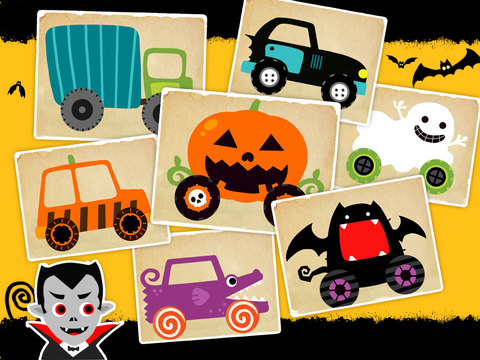
Labo Halloween Car-the kids I work with love the racing games so when I saw the Halloween Car app by Labo Lado, I had to have it.  I've used it with a few of the kids I work with and they really are loving it.  They get to choose from 12 different cars, several of them being Halloween themed (think bat, pumpkin and ghost).  They get to color it any way they want, add wheels and then add details and a character to make their car their very own.  Once they have completed designing it, they get to take it on a ride through different spooky racing routes.  
This app is great for working on improving graphomotor skills, encouraging creativity and visual motor/perceptual skills.  Also great for working on executive functioning skills, such as focus and attention and organizational skills.   
Stella and Sam Halloween Band-I've been a longtime fan of all things Stella and Sam by Zinc Roe Design since they are so interactive and work on so many occupational therapy goals.  If you haven't checked out their other apps, do yourself a favor and do it!  In this Halloween themed app, you get to join Stella and Sam in their band!  There are 6 different instruments to play.  You can change the sounds by moving the band members side to side or up and down.  If you look carefully, you will see bats, spiders and other characters floating around that you can interact with.  Great for preschoolers or young school-age children.  You can work on color recognition by having the kids hit the different colors when you ask them to.  As they get more familiar and comfortable with their colors, you can make this more complex by having them follow sequences.  For some kids, you might want to make them remember the order just by telling them and for others you may want to put out a visual for them to follow.  Kids will creating their own music while learning at the same time.  
Spooky Letters-I have a ton of great handwriting apps, but thought it would be fun to spice things up with this Halloween themed writing app by MadeByEducators.  In this app, children can practice writing upper and lower case letters, cursive letters, shapes/pictures and words.  What I really love about this particular handwriting app is that there is a big focus on phonics.  After practicing writing each letter, the kids then have to put letters in order for a word that starts with that letter or put together a simple puzzle that reveals what monster is hiding in the box.  For example, after you write the letter "K", a jumbled up word (key) comes up and they have to put them in order.  During the whole thing, the kids are hearing the letters being sounded out which is great for those who are struggling with learning how to read.
**one thing I noticed is that some of the letters that we typically start at the top (M and N for example), actually start at the bottom.  Could be confusing for some kids but there are a lot more positive things about this app that make it a good one to add to your handwriting app choices.

If you are concerned about using an iPad during therapy, keep in mind that there are a ton of ways to make it more therapeutic.  I also can't Here are a few examples of things you can do to make using the iPad more meaningful, whether it be at home or during your therapy sessions:
*use a stylus-many of the apps can be done using a stylus.  So even though the kids are absorbed in the app, they are working on developing a proper grasp.
*many of the kids I work with need to work on increasing their overall body strength, particularly upper body and neck/head.  Have them go on the net swing and play the apps.  
*if you work with groups of kids, almost any of these apps can be good for a small group setting.  They will have to compromise about colors for their cars, what to feed the monster, take turns playing instruments, etc.. There are a lot of great social opportunities available when using the iPad in a therapeutic setting. 

I would love to hear if any of you have some great Halloween or fall-themed apps that I should check out.  I like to take advantage of holidays and mix things up during my sessions.  Between the great arts and crafts activities, baking activities and the iPad apps, I have been rejuvenated the last couple of weeks during my sessions.  The kids are also having a great time and excited for new things at the gym.  So if you have any fun things to suggest to me or my readers, please share them!  I am always a click away and love hearing from you all!


Wednesday, 21 October 2015

Let's Boogie...Again!

In February, I wrote a post all about the Boogie Board writing tablet.  I was obsessed with it back then and still am.  So when I was in Mary Arnold Toys on the UES of Manhattan last week and saw the Boogie Board Play N' Trace, I was quite excited.  A quick recap for those of you who are reading who don't know about the Boogie Board.  The cliff note explanation is that it is an ultra-light LCD writing tablet (think Magna Doodle but smaller, thinner and easier to take places with you) that can be used for a variety of writing and drawing activities.  In my private practice, I will use it to practice letter and number writing to try and decrease the amount of paper I use.  We also use it to make plans and lists for the kids we work with who need that visual schedule in order to keep them organized and on task.  There are an endless amount of uses for the Boogie Board and it is one of the most recommended items when parents ask me what they can get their kids.

The Boogie Board Play N' Trace was specifically designed with children in mind.  The differences between the original Boogie Board and the Play N' Trace are:
-the shape and size:  The original Boogie Board is a light-weight rectangular shaped board that is about the size of a large envelope.  It can be easily thrown into a bag, making it perfect for passing away time on the subway, in waiting rooms, etc..  The Play N' Trace is still light-weight but larger and not as easy to carry around in a purse (great for a therapist who is traveling all around and carrying  larger bag).  It's oval shaped with a nice little thumb hole that's perfect for kids to grab onto.
-the screen:  unlike the original Boogie Board, the Play N' Trace has a transparent green screen so you can easily trace different things.  Once you are done drawing, you can place it over a darker surface so you can see the image better.  
-the stylus:  the stylus for the Play N' Trace is a little bit thicker, which is better for those little hands.  It is also double-tipped with one side being pointed like a pencil and the other beveled like a crayon.  If you want, you can put a pencil grip on it to encourage a more appropriate tripod-like grasp.  

The Boogie Board Play N' Trace can be used a variety of different ways in your therapy sessions.  I have used it for things as simple as having kids imitate lines and filling in face parts on a blank face. When practicing writing letters and numbers, it's a great tool to use because you can practice over and over again without wasting lots of paper.  Plus, I've learned that the kids LOVE to keep practicing because they can magically make their images disappear with a simple push of a button.  Each board comes with 3 sheets of letters and numbers for you to have the kids trace, but I find that they are too small for many of the kids I work with.  I am going to find larger/individual letters for them to trace from the Handwriting Without Tears book.  It's great that the board comes with some activity sheets, but for so many of the kids I work with, the letters and numbers on those sheets are too small since they are just beginning to work on learning these things.  Personally, I like to work on individual letters/numbers/shapes and letting kids master one at a time without having too much in their working field.  Since so many of the kids I work with are under the age of 5, working on mastering individual letters is far more important and effective.
In addition to all the great graphomotor related things you can work on, the Boogie Board Play N' Trace can be used for the following:
Improve Grasp-I've already talked about how you can use the Play N' Trace to work on graphomotor skills, but want to talk more about the ability to focus on working on improving pencil grip.  I like that the stylus that comes with the board and it is perfect for children who have a normal grip when holding writing instruments.  For those who don't, the stylus is the perfect size for most pencil grips.  I would suggest experimenting with different pencil grips to see what works best for the kids you are working with.   
Improve Bilateral Coordination-so many of the kids I work with have a difficult time with using two hands during writing activities.  I am constantly reminding them to take their non-dominant hand and hold the paper down during these tasks.  With this board, you have very little choice but to use two hands.  Hold the board with one hand, the stylus in the other and draw away.  When you are done drawing, you have to hold the board with one hand and erase your image by pushing the button with the other hand.  
Improves Visual Skills-there are a bunch of activities that you can do in order to work on improving visual motor and visual perceptual skills.  For example, you can draw a picture and then erase it and have the child remember what you drew and have them replicate it.  You can work on improving coloring skills by drawing shapes on the board and having the kids color them in trying to stay in the line as much as they can.  Draw simple mazes and have the kids complete them without going out of the lines.  Practice writing letters, numbers, shapes, etc..  Practice visual attention by finding simple (or more complex) images and placing them under the board and having kids trace them.  I could kep going and going but I won't bore you all...oh, the ideas are endless!

As I just said, I could go on and on and on about how great the Boogie Board Play N' Trace is, but I won't bore you any more.  What I would love to do is open the conversation up and hear how others might use the Play N' Trace during their therapy sessions or with their kids at home.  I'm always a click away and looking forward to hearing from you guys about ways to use the Boogie Board Play N' Trace.  

Wednesday, 16 September 2015

Let's Play(dough)!


Did you know that today is National Playdough Day?  Either did I but know that I do, I am going to do some really fun activities with my kids at work today using playdough!  In discovering this fact, I stumbled upon this fun list of facts about playdough.  Here are the most interesting ones:

*Did you know that Play-doh was first sold as a way to clean wallpaper?  People could remove soot and dirt from wallpaper by rolling it along the surface!
*It wasn't until 1955 that Play-doh was sold in stores as a toy?  Up until then, it was only offered in an off white color.  Once it hit the shelves as a toy they added red, blue and yellow!
*Over 2 billion cans of Play-doh have been sold since it's introduction!


Kids love playdough...and oftentimes, so do their parents.  It's a great activity that can be done at home to work on all kinds of occupational therapy and developmental goals.  Most importantly, it seems more like play than work for the kids so they are not as resistant to it.  There are so many benefits to playing with playdough.  In addition to being a great way to improve fine motor skills, it can be used to work on the following skills:
*increase upper body (shoulder and arm) strength-all that heavy work of pushing, rolling, smashing, etc. is great for building strength.  Remember, fine motor skill development is dependent on good upper body strength
*improve bilateral coordination-use different kinds of tools when playing with playdough to work on using two hands together.  For example, get an old rolling pin and have them roll the playdough into a flat surface before using cookie cutters to make shapes and other pictures.  They need to be able to use two hands in order to pick up the cookie cutters and push the playdough out of it.  All of those fun playdough kids by Play-Doh often require the use of two hands as well.
*improve manipulation skills-playdough is a perfect tool for working on improving manipulation skills such as grasping skills and finger isolation.  Have kids pinch little balls of dough using their "pinchers" or work on pointing by using their pointer finger to squish a hole into each ball.
*improve social skills-i've run many social skills groups before, and playdough is always used.  I love having it as a warm-up activity when kids are trickling in.  Sometimes I let the kids make their own creations or can have them work on something together as a group.  For example, give each kid in a group a different color of the rainbow and have them work as a group to put the rainbow together.

Here is a simple, 4-ingredient playdough recipe you can do with your kids today.
You will need:
1/2 cup of iodized salt (do not use sea salt)
1/2 cup of water
1 cup of flour (for mixing in the dough) plus an additional 1/2 cup for sprinkling/kneading
Food Coloring (this is optional but kids love color!)

1.  Measure your ingredients (except the food coloring) and put them all into a large mixing bowl.
2.  Mix ingredients together with a spoon or spatula until it starts to stick together.
3.  Once the ingredients start to come together, put your food coloring in and mix it just until it has a swirly, marble-like experience.
4.  Sprinkle flour onto a dry surface and dump the dough out and use your hands to knead the dough together.  Once the color is evenly distributed, you can begin to play!
**to store dough, place in a zip-loc bag or an airtight container***

Playing with playdough is not only fun, but therapeutic.  It can be used in therapy sessions to work on a variety of goals.  The best part is that kids are having so much fun squishing, squeezing and creating, that they don't even realize that they are doing work.  Here are some of my favorite playdough activities that you can do with your children today to celebrate National Playdough Day!

*grab a rolling pin and a bunch of cookie cutters and begin playing.  This is great for working on improving bilateral coordination, eye-hand coordination and increasing upper body and hand strength.  If you have a child who is struggling with learning shapes, numbers or letters, find some cookie cutters and work on it this way.
*roll playdough into ropes and have your kids cut the rope into little pieces with a pair of scissors.  Take a shape cookie cutter and gently press into a piece of flattened out playdough (do not push all the way through) and then have them cut the shapes out.  Great for working on improving scissor skills, bilateral coordination and strength.  
*check out this link here by a fellow OT blogger, MamaOT.  You will find 40 different playdough mats to use with your kids.  For those of you who are wondering what a playdough mat is:  they are pictures or drawing that have been laminated and encourage children to interact with the pictures using playdough.  For example, a child may need to "dress" a person, decorate butterfly wings or practice making the letters of the alphabet.  They can encourage kids to be creative and use their imagination while working on increasing hand strength and fine motor skills.  
*roll little pieces of playdough into balls and then have them pick them up and place them in a container using tongs.  This works on improving grasp strength, bilateral coordination and eye-hand coordination skills.  
*hide small beads, buttons or other manipulatives (I like to use these little animals from an old Mancala game of mine) and have the kids find them as fast as they can.  I remind my kids to pull the pieces out with their pinchers.  Once they have found all of the hidden pieces, have them hide them again for the next kid.  Great for working on improving grasp strength and manipulation skills, bilateral coordination and focus/attention.  

I have to admit, I love to play with playdough.  I love the way it feels in my hands, the way it smells and the way it can be used for a million different things (I will have to try the cleaning of wallpaper sometime).  My 5 1/2 year old daughter could play with it for hours on end.  However, my OCD definitely kicks in when people try and mix colors together!  In honor of National Playdough Day, I am going to challenge myself to pick up some fresh bottles of it for my daughter and play with her tonight and not worry for a second about mixing them up!

Do you have a wonderful activity to share using playdough?  A tried and true recipe you use with your kids that you would like to share.  I am just a click away and love hearing from you all!


Monday, 31 August 2015

Gearing Up For a New Year

Many kids have already begun the school year but by the middle of next week, after all those Labor Day picnics and parties, almost everyone will be starting school.  For some of the kids, it will be their first time going to school and for others, they will be returning to school.  While this time of the year can be very exciting, it can also bring about anxiety in children.  For many of the kids I work with, this time of the year can be difficult and parents are as anxious as they are about how the new year will go and what they can do to best prepare their children for the upcoming year.  Each of us has our own thoughts and ideas about this and it is most important to figure out which of these strategies work for your child and his/her areas of need.  As I prepare my own daughter (she begins kindergarten next week) for a new school year, I will be doing some of the following with her to get her ready and excited for all this new year has to bring.  

1.  Start your school year routine with your children the week before school begins.  This includes waking up to an alarm if necessary, eating meals the way you will during the school year and getting a bed time routine worked out before those first few days of school.  This is important for all kids, but especially those who have a difficult time with transitions and changes in routines.  If it helps, find some kind of daily schedule you can hang up for your children that they can look at before leaving the house for school so they have an idea of what to expect.  You may even want to put that schedule together right before bedtime the night before so your child can feel as prepared for the next day as possible.

2.  One of the things I remember most about growing up is the annual shopping trip for a new backpack and lunchbox.  This was super exciting and always made me feel slightly less anxious for a new school year.  Allow your children to be part of the process of picking out their new backpack and lunchbox.  If they are feeling anxious about going to school, make a big deal about showing their friends whatever they pick out.  I am one of those parents who avoids getting supplies with characters (but my daughter is more into pretty designs like clouds, stars and unicorns) but if you have a child who is into Disney Princesses, Cars or any other popular character, let them get it.  It doesn't seem like it would be a big deal but it really is!  
When picking these bags out, a few tips: 
*make sure that the backpack and lunchbox are not too big for your child to carry independently.  We send our kids to school to become more independent people, but if their bags are too heavy and cumbersome they are going to rely on grownups to take care of it for them.
*if you can find a backpack that has a lunchbox that will attach to it, even better.  I am a big fan of the new big kid backpacks by Skip*Hop.  In addition to being large enough to accomodate all the things a school age child needs to carry back and forth, there is a compartment built in for the lunch box to slip right into.  
*if you have a child who has decreased trunk strength, you might want to consider a bag that has wheels on it for them.  This way they have the option of carrying or dragging their bag.

3.  School supply shopping can be a daunting project but it is a necessary one.  My daughter starts kindergarten in a public school next week and the long list of supplies is crazy.  Since she has fine motor issues (nothing major or that warrants therapy...the poor kid has a mom who is an occupational therapist and is all over her!), I want to be sure that I get her supplies that she will be able to use and that might help support some of her difficulties.  Here are some of the things we will be getting for her and I will be recommending for the children I work with:  
Crayons-for the younger kids, especially those who may have a delayed grasp, I suggest the Crayola Triangular Crayons.  It comes in a box of 16 colors and are a bit thicker than the regular sized crayons. Additionally, the triangle shape helps encourage a tripod grasp when using them.
Colored Pencils-again, I am a fan of any of the Crayola colored pencils.  For the smaller hands, their Pip-Sqeaks Colored Pencils are perfect.  As they get older and still struggle with using a proper grip, you might want to consider getting the regular sized pencils and breaking them in half. The smaller the writing instrument, the more it encourages a proper grasp.
Scissors-I have always been a fan of the Fiskars blunt-tip scissors.  They are the perfect size for those little hands.  They also have left-handed scissors which not all companies carry.  You can find them in almost all chain drug stores but their website also has a large selection and you can find the exact color for your child!
Student Planner/Assignment Books-some schools now give each student a planner at the beginning of the school year which I think is amazing.  Many of the kids I work with struggle to keep their assignments organized, often forgetting what each of their teachers has asked them to do.  As children get older, they need strategies in order to keep themselves organized and more independent for classroom success.  Go to Staples or book stores and look at their selection and figure out which would be best for your child.  There are so many to choose from and there may be something about one that is better than another for your child and his/her needs.   It's important to go over what you expect from them when using this book.  Be sure to go over this before the school year begins and maybe even copy a few pages so you can do some practice runs before they have to use it for real.  
Folders-I don't care what brand you pick out but do have some suggestions, especially as kids get older.  First of all, if you have a kid who has difficulty keeping their backpack clean and organized, get those thick folders made out of plastic.  They can take a beating as they are shoved into their bags!  Also, I would suggest getting different colored ones for each subject so they don't have to open and close each one every time they need to complete an assignment.  If you have an older kid who you need to come up with organization strategies for, you can consider getting a binder to put all of the folders in so everything is in one place.
Pencil Case-be sure to find a pencil case that is big enough to carry what your child needs, but not so big that they have a hard time finding all they need.  If you have a child who presents with difficulty with organization and other executive functioning skills, you may want to find something that has compartments so it is easy to find everything when they need them.  You don't want your kids to lose out on time to complete assignments because they are too busy digging through their pencil case.  I am a big fan of this one here by Yoobi.  It's a little larger than the typical case, but it you can definitely find what you need when you need it without a problem.  Be sure to check out all the other products on Yoobi because for each product you purchase, they will donate one to a classroom in need.  

4.  A new school year can be most difficult partly because of all the new faces that a child may have to learn.  For kids who have learning, language or sensory delays, this is even more challenging.  Many of the kids I work with don't only have to worry about new teachers, but new therapists both in and out of school.  When possible, try and schedule a meet and greet with your child's new teacher and therapists prior to their first day with them.  While on these meet and greets, you can ask to take pictures for them to go back and look at leading up to their new schedule beginning.  You can also use these pictures to set up some kind of visual schedule for your child to look at the beginning of each day so they know where they will be going, who they will be seeing and what they can expect from their day.  This seems simple, but it can go a long way in setting your child up for a successful day.  

5.  It may seem crazy, but since I have a kid who is a picky eater I have to worry about her snacks and lunch for the school week.  Summer has led to bad eating habits (you know, eating ice cream for dinner or snacking on junk food during the day instead of having dedicated meal times) for us and one of my biggest concerns is will she have enough to eat during the day to ready her for brain learning all she has to do.  Packing protein filled meals is important to keep our kids from being hungry.  And since there are so many classrooms that are peanut and nut free, we have to become creative in what we pack for our kids.  When possible, take your child shopping for snacks and lunch foods.  I find that when they get to help choose them, they are more likely to eat them.  For kids with fine motor, sensory or feeding difficulties, be sure to pack foods that your child can eat independently.  Cut food into small, bite-sized pieces so they can easily take a piece with a fork or use their fingers.  If they have a hard time with using spoons, get squeezable fruit packs, applesauces or yogurts so they don't have to worry about using a spoon or asking for help.

Do you have any back to school tricks that you would like to share with my readers?  Any strategies that you have used with your sensory sensitive kid that made the transition back to school that much smoother and easier for not only your child, but your family leading up to the first day of school?  I am sure us parents and therapists have a lot of advice we can offer one another to make this anxiety producing time of the year less stressful and more enjoyable.  I love hearing from each and every one of you and hearing your helpful advice and know that when you share it with me, you are sharing it with tons of others!  I am only a click away and look forward to hearing from you!

As you all, parents, therapists and especially the kids that we love, begin this new school year, I wish you a wonderful and exciting year!  

Friday, 1 May 2015

Eye Spy the Difference

I'm always downloading new apps.  It's just something I love to do and expose the kids I work with to.  At least once a week, I go onto the App Store and see if anything wonderful catches my eye.  This past week, I discovered an awesome app, Toonia Differences.  It reminded me of this game that my sister Katie and I first started playing at a local bar ages and ages ago, Photo Hunt.  The point of the game was simple (yet totally stressful):  look at the same picture side by side and find what is different.  When it became available as an app, I spent countless hours playing it and got such satisfaction from beating a friend or a previous score.

Toonia Differences is the cutest "spot the difference" game for kids that I have seen.  Very much like the game I described above, the object of the game is to look at the side by side picture and notice the 8 things that are different.  Some are obvious at first glance and other are much trickier to spot.  I first tried this game with my daughter who turned 5 in March.  After explaining the rules of the game, she caught on quickly but required prompting from me to only touch one of the images that were different....her initial instinct was to hit the images on both pictures which caused her time to increase which then lead to frustration.  This game requires a child to really focus and attend to what is on the screen.  The app uses simple graphics and colors with quiet/organizing music playing in the background.  Since there are so many details in each picture, the differences can change over and over again so the kids don't get bored or memorize the things that are different.  Kids of all ages are loving this game and I really like that you can change your expectations for each child you are working with based on their level of functioning.  For younger kids, you may have to provide them with some subtle hints to get them to find the differences.  For the older kids, you can have the kids explain what they notice before touching the screen.  If you are working on handwriting skills, you can have them write down what they notice...make sure they go into detail and write full sentences!

This app works on the following occupational therapy goals:
Improve Visual Perceptual Skills-there are so many visual skills that can be worked on with this game.  Visual scanning, visual tracking, visual attention...I could go on and on.  The great thing about it is that the pictures are cute and the kids really like them. If you want to work on improving eye-hand coordination, you can have the child play the game while using a stylus.
Improve Language Skills-clearly, speech and language isn't my area of expertise, but I can't help but notice how much a speech therapist could work on improving language skills using this app.  For my older kids, I have been having them describe the differences in the pictures before they can touch the screen.  This sounds easy, but so many of my older kids struggle with this task...they recognize what is different, but putting it into words is tricky for them.
Improve Modulation/Regulation Skills-for so many of the kids that I have tried this game with, their instinct is to just start tapping away and hoping that they find the differences by luck.  They have needed prompting from me to be mindful and attentive to what they are looking at, making sure that they are really finding the images that are different.  I try not to focus on the fact that there is a timer tracking their work (and thankfully, very few of the kids I have played this with have noticed that) because once they realize that they were being timed, they became much more impulsive and less focused.
Improve Social Skills-this is an ideal app for improving social skills and can easily be done in a group of two or three kids.  You can work on taking turns finding the differences.  You can also have the kids work together to create stories about what is happening in the pictures.

Toonia Differences is available in the app store and the first 5 pictures are free.  There are a variety of sets available via in-app purchases for $2.99 or their super pack (45 pictures) for $6.99.  For the amount of time you can spend on this game and all the skills that can be focused on, I think it is totally worth splurging on the whole collection.

If you wanted to do something fun with your kids, you can make your own Spot the Difference game using your own pictures.  One thing you can do is take pictures of different places in a child's life.....their bedroom, their classroom, etc..  Take the pictures on different days so the environments look different.  Print the pictures out and put them side by side and see if they can find all the things that are different.  This could be a really fun project to do with a social skills group....have each kid bring in a few different sets of pictures from their house and put together a book.

Finding a good app is still one of my favorite things.  Sharing those finds with my readers is another one of my favorite things!  This is a great app that parents can do with their kids while being able to work on occupational therapy goals in a fun way.  Kids can play it with their friends or siblings.  Do you have any great new apps that you have discovered lately?  As the end of the school year approaches, I would love to be able to put together a list of fun and educational apps that parents can do with their children over the summer.  Please share your favorite apps with me...I'm just a click away and love hearing from you all.


Friday, 17 April 2015

Spring Has Sprung!


After what seems like the longest winter ever, spring has finally arrived in my corner of the world (Park Slope in Brooklyn, New York).  Flowers are blooming, windows are open more than closed and there is no sign of snow or winter anywhere.  Don't get me wrong...I love winter and all that comes with it.  But when March and April roll around, winter gets gross in New York City.  The snow is dirty and when it finally melts, there is so much gross stuff on the sidewalks that you want to walk around with your eyes closed.  So the fact there are flowers growing and birds chirping is totally welcome and exciting for me.

As an occupational therapist, there are a lot of exciting things that can happen therapeutically once the warmer weather arrives.  Parents are always asking me for things that they can do with their children to get them outside, get them moving and get them away from the television and other electronics that tend to be used to entertain our kids during the colder months.  I typically see a huge jump in skills with the kids I work with this time of the year because they are spending more time outdoors in the park or at the playground.  They are watching the big kids do things and they want to try and be just like them.  After months of therapy and boosting their confidence in their skills, kids who were once timid about taking risks at the playground are trying things they couldn't do before.  They are spending more time socializing with other kids and less time indoors so you tend to see a huge boost in their language skills as well.

Below, you will find a handful of activities that I suggest to parents to try with their kids in order for them to carryover some of the things we are working on in our sessions.  In order for kids to really learn skills, they need to be able to generalize them in different environments.  All of the activities will work on improving fine motor, gross motor and sensory processing skills.  They also can help in developing improved language and social skills.  Most importantly, they are guaranteed to be lots of fun!

Grow a Garden-in NYC, we don't always have the luxury of having a lot of space for such things.  With that said, my husband and I have found a way to get our 5 year old daughter into gardening in the last couple of years.  We are fortunate to have a garden in front of our brownstone and can really garden with her and it has been such a great experience for her.  If you don't have the outdoor space, you can get a couple of clay pots and have your kids grow herbs or flowers that don't require a lot of sunshine to grow.  Gardening is good for so many occupational therapy related goals from the moment you pick out the seeds to that magical moment when the flowers actually bloom.  Have kids fill up pots with soil using kid sized gardening tools.  This is great for working on building upper body strength, bilateral coordination and improving eye-hand coordination.  If you have a child who presents with tactile defensive behaviors, encourage them to use their hands to put the soil into the pot to work on that.  Gardening also teaches kids responsibility and gives them an opportunity to have a "job" every day.  Use a spray bottle to water your plants every day; this will work on increasing grasp strength and bilateral coordination skills.  Check out this adorable Garden Tote with tools perfectly sized for your little ones.

Ride a Scooter-in the winter, it's easier to get from place to place by throwing your kid in the stroller and not having to worry about them getting cold or slipping on the ice.  Now that it is nicer out, make sure you leave enough time in your day to allow your kids to get themselves to places on their own two feet.  Whether it be walking or scooting, getting your kids moving is key.  My favorite is the Mini Micro Kick scooter as I have found that it is light weight and easy for the kids I work with to use.  Even the kids on my caseload who have difficulties with balance, coordination and motor planning have success with this scooter.  So many parents come to me and tell me that the hardest time of their child's day is starting the school day.  Oftentimes, I find that kids are rushed through their morning routines, thrown into their strollers so they can be brought to school on time and then are thrown into the morning craziness and get overwhelmed and have difficulty.  When possible, I suggest to parents that they let their kids walk part of the way.  Even better, let them scoot the whole way.  It provides them with an incredible amount of organizing input to their sensory system.  The foot to pavement action gives them a ton of deep proprioceptive input that helps kids to be more organized and ready for a great day at school.
**one of the biggest complaints I get from parents about getting their kids to use a scooter is that they don't like the helmets and how they feel.  Take your kid to the store with you and have them try on helmets and let them pick which one they want.  Kids are way more likely to wear a helmet if they feel like it's one that they really like!

Chalk It Up!-one of my favorite things about the warmer weather is coming home at the end of the work day and seeing my own daughter outside drawing with chalk in front of our apartment.  She has learned how to write her name, draw pictures of people and so many other great things.  Writing with chalk is a great activity and can really be most enjoyed during this beautiful spring weather.  There are so many chalk choices these days:  think, thick, one colored or rainbow, egg or square shaped.  Keep in mind that using thinner chalk will most resemble a writing instrument in turn encouraging a proper grasp when using writing instruments.  If you can, have your kids draw on an elevated surface to work on increasing upper extremity strength.  If you don't have a driveway or a place in front of your apartment, grab the chalk and go to the playground.
You can make this a social experience by gathering a few kids together and having them make pictures together.  For example, draw a picture of a person and have each kid add their how part to complete the person. Or play a game of tic-tac-toe or hangman.  You can work on letter recognition, executive functioning and social skills at the same time!  If you have the space, you can have your kids draw a hopscotch board so they can work on improving gross motor skills too!

Bubblerama!-I don't know what it is, but kids and bubbles go together like bread and butter.  They just love blowing them, chasing them, catching and popping them!  A fun thing you can do with your kids is make your own bubbles.  Sure, you can go out and buy bubbles anywhere, but making them can be really fun and is really easy.  It is also great for working on a lot of occupational therapy goals in such a fun way that your kids don't even realize that they are working.  For example, you can work on improving bilateral coordination (holding bowl while pouring ingredients in and stirring all the ingredients together), increasing upper body strength (stirring the ingredients) and working on improving executive functioning skills like focus, attention and organizational skills.  For older kids, you can give them a list of all the supplies needed for the activity and have them gather them before beginning.  You can also write out the steps on a piece of paper, cut them into strips and have the kids put the directions in the proper order before beginning the activity.

To make your own bubbles, check out this recipe:
6 cups water (you can use tap but distilled is better)
1/2 cup blue Dawn dish detergent
1/2 cup corn starch
1 tablespoon baking POWDER
1 tablespoon glycerine

Dissolve the cornstarch in the water, stirring really well.  Once the cornstarch is completely dissolved, gently stir in the remaining ingredients (in no particular order) trying to not make too much froth.  Let the mixture sit for at least an hour, stirring occasionally if you see that the cornstarch is settling to the bottom.   Don't get discouraged if your first few bubbles don't come out too great...the mixture gets better after a few uses.

You can use bubble wands and blow bubbles (great for improving oral motor strength) or you can make your own super big bubble wand using straws and yarn (you need your yarn to measure about 6 to 8 times the length of a straw).  Take the yarn and string it through the straws, tie a knot and you have your bubble wand.  You can take your bubble solution and put it in a big bucket and start making giant bubbles!  Guaranteed fun for kids of all ages!


These are just a handful of fun and simple activities that you can do with your kids now that the weather is nicer.  I have chosen activities that can be done whether you live in the city or in the country...they just may need to be adapted based on what kind of space you have.  What are you most excited about doing with your kids now that spring is actually here?  Please feel free to share your fun outdoor activities with me and my readers.  I'm just a click away and love hearing from each and ever one of you!   I am looking forward to a fun-filled outdoor weekend with my own family and wish you all a very happy and warm weekend!


Monday, 30 March 2015

Eggcellent Crafting!

Easter is less than a week away.  I love Easter.  I'm not sure if it is knowing that Spring really has to be close if Easter is happening or if it's the candy or if it is the decorating of eggs that makes this one of my favorite holidays.  Actually, is is the candy...I've been hoarding Cadbury Mini Eggs since Valentine's Day was over.  But I really do love the other things about Easter too.  And I love having a reason to do some fun crafts and activities with the kids I work with.  Holiday weeks tend to mean that I have a week of very focused and organized activities set up.  Since many of the kids I work with don't celebrate Easter, I have backup activities that focus on Spring instead.  Here are a few of the things I will be doing with the kids I work with this week.

Fingerprint Bunnies and Chickens-I am a TOTAL sucker for any activity that involves fingerprints and Spring and Easter lend to this idea quite well.   When I think of spring, I think of bunnies, baby birds, chicks and other animals.  While the image I have shared shows these on eggs, this can be a spring related activity for those kids who don't celebrate Easter.  Fingerprint art is a quick and simple activity for kids of all ages.  It can be easily adapted to increase or decrease the expectations for whatever child is doing it.  For example, for your younger kids, you can have them do the very basic putting their fingers in the ink and pressing it on the paper and the grownups can add the details to the thumbprints.  As they kids get older, you can increase the expectations by asking them to add the details to the pictures.  For even older kids working on handwriting, you can have them make Happy Easter or Happy Spring cards for family and friends.  The best part about this project is that the supplies are minimal and that it takes a short amount of time to finish so the kids can take their picture or cards home with them right away.

Jelly Bean Sorting Game-as I have already mentioned, one of the things I love most about Easter is the candy.  I know that is what makes it a favorite holiday for a lot of the kids in my life.  So, why not make it into a fun learning opportunity?  This jelly bean sorting game is easy and can be easily adapted for kids of all ages.  Minimal supplies needed:  a bag of colorful jelly beans, plastic eggs, an empty egg carton and a pair of child friendly chopsticks (my favorite are the Zoo Sticks by Hog Wild).
For younger kids, place how ever many colored eggs into the carton that you want them to sort.  Put a bowl full of the same colored jelly beans in front of them and have them sort the jelly beans into the proper color.  Encourage them to use a pincer grip to pick up the jelly beans.  For older kids, add more colors and instead of using their hands to put the jelly beans in, have them use the chopsticks. By adding the chopsticks, you are working on increasing grasp strength and in-hand manipulation skills.  If you want to add an element to work on improving bilateral coordination, you can have them pull the plastic egg out of the carton with one hand and have them pick out all the like colored jelly beans with their other hand.  For an increased challenge, you can have the kids open up the eggs and hide a number inside and the kids have to put that number of jelly beans into the eggs.

Tissue Paper (scrap paper) Easter Egg/Tulip-again, another activity that can be easily turned into a spring project instead of an Easter one.  You can either have the outline of an egg or a tulip on a piece of thick white paper.  Have lots of small pieces of tissue paper in pastel colors available for the kids to choose from.  Depending on the skill set of a child, you can have them take the square pieces of tissue paper and place them the picture or have them scrunch them up into little balls (great for working on increasing grasp strength and manipulation skills) before placing them on the paper.  To work on improving grasping skills, you have have the kids use a paintbrush to put the glue on the paper (just a tip that you don't want them to paint the whole picture in but do small portions at a time in order to prevent the glue from drying).  For older kids, you can draw patterns on the eggs and have them use different colored tissue paper for each section.  This is a great activity for not only working on fine motor skills, but can work on color recognition, improving eye-hand coordination, biilateral coordination and focus and attentional skills.  One adaptation you can make to this activity is to use fun scraps of paper and have the kids tear them into pieces and then glue them onto the egg or flower template.

I have already tested these egg-celent activities out at work with the kids and they are all a big hit.  They are all simple, require few materials and can be finished during one therapy session which is a huge thing with the kids I work with.  They LOVE to be able to take their work home and show it off to their people.  

Do you have any great Easter or spring activities you love to do with the kids?  I'd love to hear from any of you with activities that you have found success with and that the kids have really loved?  Please share any ideas that you may have...I'm always a click away and love hearing from you all.


Friday, 27 March 2015

Avokiddo Apps=A+ Apps

One of things I love most is finding a good app. Even better is when the design studio who created that app has several wonderful apps to choose from.  Two of my favorites, Toca Boca and Pepi Play, come up with new apps all the time that always blow my mind and I have blogged about several of their games.  Recently, I discovered a new studio and I can't get enough of their apps.  More importantly, the kids I work with are loving all the new apps on my iPad!

Avikiddo is an award-winning creative studio that specializes in creating quality educational apps for children.  They believe that when somebody enjoys something, they will connect with it in a way that learning will take place more naturally.  And I LOVE their philosophy (which I am sharing directly from their website):  Our philosophy is that education should be more than teaching math and literacy.  It should provide a challenging and stimulating environment where children obtain knowledge through active exploration and interaction.  An environment where they can use their imagination to reveal their true inner self; a world infused with purity and creativity.  We design our games with love and affection, truly believing in these principles.

I was originally drawn to the Avokiddo apps because of the awesome graphics.  There was something unique and creative about it that I hand't really seen before and thought I would check it out.  My fiIt's impossible to choose just one favorite of the Avokiddo apps so I have decided to write a little something about each.

Beck and Bo-a delightful and incredibly interactive app that takes two kids, Beck and Bo, on an adventure through 12 different scenes.  I would highly recommend this app for speech therapists and special educators who are working on building vocabulary.  The scenes vary from a day at the beach to building a snowman.  Each scene starts of pretty empty and it is up to the child to grab different objects falling from the sky and place them where they want in the scene.  For example, the winter scene starts off with snowy hill and you have to grab different parts of a snowman and put it together, including a hat and scarf.  From an occupational therapy perspective, this app is great for working on visual motor and visual perceptual skills.  It is also great for working on improving executive functioning skills such as attention, focus and organizational skills.  If you are working on improving grasping skills, you can always use a stylus to encourage a proper grasp on writing instruments.  Want to work on increasing upper body strength?  Have them play this app while lying prone either on a bolster or on the net swing.  They will be having so much fun that they won't realize how much they are "working" on getting stronger!

Avokiddo Emotions-this was my first Avokiddo app.  I was running a social schools group for preschoolers and we were focusing on emotions with the kids.  The iPad always motivates my kiddos and I did a search and found this.  It was a huge hit with the kids.  One of my favorite things about this app is how it allowed the kids to freely interact with different characters and then generate conversation about how they reacted.  It allowed them to really look at the animal's faces and recognize what different emotions looked like.  For example, the characters ears flatten and droop down when they are sad or they would jump up when they were startled by a loud noise.  For generalization purposes, we then would act out different emotions with the kids after we played the app.   This is a great app for working on speech and language skills and making kids more aware of social cues.

Thinkrolls-I just recently discovered this app and am loving both the original and the newest version which was just released on Wednesday!  Great for older preschoolers and school age kids.  It's a highly addictive game that has kids roll a variety of adorable characters through mazes.  While going through the maze, the encounter different challenges that requires them to think about how to use them.  They also unlock new characters which I have found makes for a really excited kid!  For example, as they are rolling through one of the earlier mazes, they run into a blocked path by a cracker that they must eat to keep going through the maze.  As you go through the levels, you may be blocked by a balloon that must be popped by the spikes on the wall or drop ice cubes on a fire so they can pass it.  One thing I really like about this game is that it is great for kids as young as 4 and as old as 9.  It's great for working on visual motor/perceptual skills like tracking and scanning.  Most importantly, I love how it works on problem solving and critical thinking.  It makes kids have to slow down and think about what they are going to do in order to pass the obstacles.  As they move through the mazes, they start to combine the different obstacles so the kids really have to think about what each thing does and make sure they do it in the right order in order to pass the obstacle.  This is a great app to work on improving social skills; you can have kids work together to talk about how to  overcome the challenges and take turns moving through each level.
Thinkrolls 2, the new version of Thinkroll does not disappoint.  It's the same concept of rolling through a series of mazes, but there are new challenges and characters introduced. Like the original Thinkrolls, kids are required to roll their characters through mazes, using problem solving and critical thinking to figure out how to overcome challenges.   Both games offer two levels of play, easy and hard, that makes this great for children of all ages.  Even adults will have fun playing this game and will find themselves stumped at times as they the game becomes increasingly more challenging.

Avokiddo ABC Ride-one of my absolute favorite alphabet apps out there!  Like all the other apps already discussed, it is incredibly interactive and engaging making learning super fun for the kids playing it.  The game starts off by choosing your character, Beck or Bo, and putting them on a bike and have them go on an alphabet adventure (you can go in order or have it be random).  Each letter has a mini-game to get the kids engaged and helps them associate a letter with a word.  For example, water the flowers to find the F or put the robot back together for the letter R.  My favorite is C where you have to cram the candy the hippo is dreaming about into his mouth.  Not only are the kids learning about the letter, they are working on following directions, matching pictures and maintaining their attention/focus.  Once the child has completed each mini-game, a whole word will show up on top, the letters will drop and the child has to match/drag the letters back into place.  This app is great for working on more than just learning letters.  It works on improving visual motor/perceptual skills, eye-hand coordination, following verbal directions and improving focus and attentional skills.  For my older kids who are working on handwriting, I have them write the words before they move onto the next letter for an added step.  

Do you have any other design studios you really love?  Any games that you want to recommend to me or my readers?  I am always on the lookout for good apps, especially ones that will work on a ton of skills, motivate the kids I work with to learn and ones that can encourage social skills at the same time.  I would love to hear from you and am always a click away!  In the meantime, I hope you and your littles enjoy these apps!


Friday, 6 March 2015

Game On!

Last week I talked about how I was pretty much bored of all of the apps and toys I have been using since September.  It's not that they aren't fun or have lost their therapeutic value, it was just that I needed a change and something new to motivate the kids I work with.  I am pretty sure I heard some sighs and saw some rolling of the eyes in the last few weeks as I pulled about Barnyard Bingo and Whac-A-Mole!  I spent some quality time with Amazon and found a couple of great games by Educational Insights that have been a hit with the kids at work.  
First of all, I'd like to take a moment to talk about this company.  There isn't one thing that they have created that I haven't loved.  All of their games are fun, motivating and incredibly well made which means that they can handle the wear and tear of lots of kids handling and playing with them at the gym I work with.  As an occupational therapist, I adore that the games all have a fine motor component to them and can be graded to make it appropriate for pretty much any child on my caseload.  I don't have any of their actual toys, but as I was searching through their collection, I found many things that I will be adding to my collection very soon.  For example, check out these two drill sets:  Design & Drill Dazzling Creation Studios and Design & Drill BrightWorks.  I know a lot of kids who would flip out over these!

The two games that I picked up this week have been a hit amongst all the kids I have tried them with.  They have provided a just right challenge while working on a lot of different occupational therapy goals.  

Crazy Cereal-this electronic game is a fast-paced, exciting 2-player game that requires kids to match colors.  The game consists of 3 bowls (two small bowls for each kid to collect their cereal pieces and one large one to be placed in the middle for all the cereal pieces).  Each child grabs a bowl and a spoon, turns their spoon on and let the cereal grabbing begin.  The spoon lights up different colors and the child is expected to pick up whatever color it flashes one at a time.  Every once in a while, the spoon goes crazy and flashes all different colors at which point they can pick up two pieces of any colored cereal at a time.  I have modified the game for younger kids by not having them turn the spoon on (it moves pretty quickly) but by calling out the color that I want them to pick up instead.  Great game for working on color recognition and matching.  In addition that the aforementioned, Crazy Cereal works on the following occupational therapy skills:
Improve Bilateral Coordination Skills-great for working on using two hands in a coordinated manner.  As the kids are collecting the cereal, they need to hold onto the spoon with one hand and the bowl with the other.  
Improve Fine Motor Skills-once the kids have completed the game and have collected as many pieces of cereal as possible, I like to have them put the cereal back in the big bowl using a pair of Zoo Sticks.  This is great for working on grasp strength and manipulation skills.  
Improve Eye-Hand Coordination-kids must look at their spoon and watch for what color it will turn before picking up their cereal.  I have to remind the kids quite often to look at the spoon after they collect each piece of cereal as the spoon changes color pretty quickly.
Improve Executive Functioning Skills-this game requires a tremendous amount of focus and attention in order to be successful.  If they aren't keeping their eyes on the spoon in between turns, they will often pick up the wrong color.  They also have to remember to pace themselves and only pick up one (or two) pieces of cereal at a time.  This requires them to regulate and be in control of their actions, which can be quite challenging when kids are excited and really want to win!  For older kids who are working on sequencing and organizing their work, you can have them read the directions and then tell the other kids the rules of the game.  
Improves Social Skills-while this game can be played independently but is way more fun playing with a friend.  It works on promoting good sportsmanship, especially learning how to be a good winner and loser!


Pancake Pileup-when I saw this game, I was sold by the fact that it was a physical game that got kids up and moving around the gym.  This has been a long, cold and snowy winter and so many of the kids I work with who benefit from running around outside have spent a lot more time sitting inside.  This game is not only great for occupational therapy but also for improving gross motor skills.  It is a fun movement game that has kids copy stacks of different flavored pancakes shown on a card.  Using a spatula, kids have to pick up the correct pancake and walk them over to their plate.  The child who finishes theirs first without making a mistake is the winner.  Depending on the age/skill level of the children playing, you can have them each pick up their own card or have them do the same card.  This is another one of those great games that can be adapted to be appropriate for all children.   I also love it because it can be done in a group as small as two but can also be done in classrooms or small social skills groups.  In addition to what has already mentioned, Pancake Pileup can work on the following occupational therapy goals:
Improve Eye-Hand Coordination-kids need to use eye-hand coordination as they scan the pile of pancakes for the correct pancake, as they pick up the pancake with the spatula and also when they are placing it on the plate.  
Improve Motor Planning-I've really enjoyed watching the physical therapists I work with play this game with the children they are working with.  They have been using it with just one child so they can be a little more creative.  While this game works on balance and coordination, it can also be played while doing a simple obstacle course.  Or you can play it while having a child walk across a balance beam or while stepping on stepping stones.  The kids have to be mindful of the obstacles that have been created.  
Improve Focus and Attention-the point of the game is to get your pile of pancakes stacked up as quickly as possible without dropping them from your spatula.  Kids need to focus on maintaining their attention to what they are doing because if they start looking around and drop the pancake off the spatula, they will have to start again.  
Improve Social Skills-great game for working on building sportsmanship, especially how to be a good winner or loser.  If playing in a larger group, you can work on teaching kids how to be part of a team, how to cheer their friends on and how to build up tolerance for others when they mess up. If you have a small group of kids, this is a great game to do relay-race style to work on taking turns and work as a team.  

It's so great when you find games that can be used in both therapeutic and social environments.  These are just two of many of the great games by Educational Insights.   When parents ask me for suggestions on what they can do with their children at home, I'm always happy to give them games and activities that can work on achieving our goals in a fun and stress-free way.  I love when kids are so comfortable with a game that they are able to tell the rest of their family how to play it.

Do you have any great new games that you like to recommend to families?  I'm still on the lookout for a few more new and exciting things to do at work and would especially love some more games that get the kids up and moving since this crazy weather has kept a lot of kids stuck inside for days on end!  I'm always a click away and love hearing from you all.


Saturday, 28 February 2015

App Happy

I have had a really hard time keeping up with my blog these last few months.  Between the holidays and being buried with paperwork and reports, writing has been put on the back burner.  I'm happy to have a little time on this chilly Friday afternoon to write a quick blog about some of the fabulous apps I have been using at work these days.  I'm not sure if its the weather or the time of the year, but I basically got bored of every game, app, etc. that I have been using and if I was feeling bored, I can't imagine how the kids were feeling.  The following apps are ones that the kids love but also work on a ton of great skills.

Metamorphabet-this interactive alphabet app came out a few weeks ago and not only have the kids loved but every grownup I have showed it to as well.  My husband and daughter spent nearly an hour going through each letter one night.  Metamorphabet is a playful and interactive alphabet app appropriate for all ages.  With each letter there are several surprises that unfold as you poke, prod, drag and spin the letters around.  It is a wonderful educational tool, motivating kids to learn their letters in a playful way that makes it seem like more fun and less work for them.  Learning the alphabet has never been so much fun!  There are several ways to make this more therapeutic and educational if you want to use it at work.


Labo Paper Fish-another interactive game that the kids are loving!  Labo Lado has several create and play apps that all look fantastic and that I plan on checking out very soon!  Paper Fish is great because it works on improving visual motor, visual perceptual and organizational skills.  First kids get to choose one of 16 different fish templates that they will need to "cut" out; they need to trace the
lines of all the different parts of the fish in order to do that.  Once they are all cut out, they need to put the fish back together.  I like that if you go too fast while tracing, it stops and makes you go back; this is great for those kids you work with who rush through their work.  They can keep the fish simple or decorate it themselves to make their very own fish.  After they are all done creating the fish, there are 5 different games that can be played.  Each mini-game is fun and I like how they all work on different visual motor and visual perceptual skills.  My favorite is when you have to take pictures of fish while underwater; a picture of a fish will show up in the top right hand corner and you have to scan the sea to find the matching fish, drag the camera over and take a picture of it.

Pepi Ride-there isn't an app by Pepi Play that isn't a big hit with my kids.  Pepi Ride is no exception and is especially popular with the boys on my caseload who have a need for speed.  This app allows children to choose a character and create the car they will ride in.  They can make it as simple or complex as they want.  Once their car is complete, they can take the car out on the road for some adventures.  There are 9 different driving courses and as you go through the map, the difficulty level increases.  While this isn't complicated, it's a great app for helping kids make choices and really think about what they want to do.  So many of the kids I work with have a difficult time with organizing their thoughts/work and I like that this app can help them work on that.  Some of the racing games out there are super fast paced and have a time-limit which tends to be difficult for the kids I work with causing them to get frustrated and upset with themselves.  This is a nice racing game for younger kids because the goal is simple:  finish each course and pick up the 3 presents along the way for extra points.

Shape Arts: Geometry Creations-I can't tell you how hard I have been searching for a great tangram app (I love Osmo but I wanted something else as well).  Lighthouse Learning has a bunch of great math apps for kids of all ages and I am in love with Shape Arts.  Not only are there hundreds of puzzles for the kids to complete, there is also an option to make their own puzzles.  There is a template provided and each one has 7 shapes that must be moved into the puzzle to complete it.  Some fit in perfectly while others may have to be rotated before it fits in.  This app is not only educational, it is also fun while working on improving visual motor, visual perceptual and executive functioning skills.  While it says that this app is for children 7 and older, my almost 5 year old daughter was able to play it with minimal help from me.  

Toco Pet Doctor-this is not a new app but continues to be a big hit with the kids that I work with, especially the younger ones.  And for those of you familiar with Toca Boca, you know that there isn't a single app of theirs that isn't amazing.  There are 15 different pets waiting in the vet's waiting room with a variety of ailments that need to be tended to.  Choose an animal and make them healthy.  You may need to clean and bandage up a cat's ear, pull gum off a bird's foot or brush the messy teeth of a hamster.  Once they are all taken care of, you have to feed them.  None of the activities are overly challenging but require children to maintain their focus and attention on what needs to be done.  Great for working on improving visual tracking, visual perceptual and visual motor skills and can be worked on individually or in a group of two or three kids to work on improving social skills.

I know that there are still many therapists who don't agree with using an iPad in their sessions which I totally respect and appreciate.  I have found that when used in moderation and with other therapeutic interventions, it can be a highly effective and motivating tool.  I have found it to be most helpful with teaching handwriting to my more resistant kids because it is so interactive that they forget that they are actually working.  I never just do the handwriting apps alone but will have them practice the letter on the iPad and then immediately have them do it on the Boogie Board, dry erase board or on a piece of paper to generalize the skill.  There are so many wonderful apps that really address improving visual motor and visual perceptual skills in a fun way.  All of the apps I discussed above work on that skill.  In addition to what I have already mentioned, the iPad can be used to work on the following things:
*work on increasing upper body strength by playing the iPad while lying prone on a net swing or on a bolster
*work on improving grasping skills by requiring a child to use a stylus whenever it is appropriate to. iCreate crayon by Fred & Friends and the Mini Retro stylus by Kikkerland Design
 I will stop kids during play to encourage them to switch their grip.  My favorite stylus' are the
*work on improving bilateral coordination skills by making sure kids hold the iPad with one hand and use their dominant hand to play the game
*work on improving social skills by having kids play appropriate apps together
*work on improving executive functioning skills such as organization, attention/focus, working memory, sequencing, etc.

I love using the iPad at work and especially love when I find new apps to share with my colleagues and the parents I work with.  It's an easy way for parents to be able to work on some of the things that we work on in therapy and get them more involved in their child's therapy in a fun and less stressful manner.

Do you have any new apps that you just can't live without?  I'm always looking for new and interesting ones and would love to hear what's hot with your kids and I am sure many of my readers would love to hear as well!  Please share your favorite apps...I'm just a click away and love hearing from you all!