Showing posts with label visual motor. Show all posts

Monday, 15 February 2016

It's Okay to Play With This Food!


It's been a while since I found a new game that I felt worth sharing.  To be honest, when I find something, it sticks around for a while.  For example, Tumbling Monkeys and Wok N' Roll have been part of my work routine for as long as I can remember.  When I read about how cold it was going to be this past weekend and that I would be entertaining not only my daughter but also another friend of hers, I decided it was time to add some new games to my daughter's collection. I went into my local toy store, Little Things, in Park Slope and could have gone a little crazy.  I was drawn to many of the educational games but knew that it wouldn't be well received by my daughter who is officially on winter break.  Instead, I went with a game that help work on improving her fine motor skills, particularly something that might help promote a better grip.  Yeti In My Spaghetti, by Play Monster (formerly known as Patch), was a HUGE hit with both my daughter and her friend.

I like when games are simple and easy for kids to play...that means that grownups don't have to struggle when reading the directions in order to figure out how to explain the game to said kids! How many of you have purchased a game like that and then never played it because you just couldn't figure it out??  Nothing frustrates me more!  Even better, there are no batteries required which means that this is a quiet game free of noise and lights!  The object of Yeti In My Spaghetti is quite simple:  place the 30 pieces of spaghetti over the bowl in a criss cross pattern and then place the Yeti on top of your pile.  Choose who is going to go first and begin pulling the spaghetti out from under the Yeti without letting him fall into the bowl.  You must be mindful, look at what you are doing and take your time when pulling the spaghetti pieces out because if the Yeti falls while you are pulling it out, the game is over.

Besides the fact that this game is fun, it is great for working on a ton of skills for your little friends (I can't help but let my occupational therapy brain go there).  Ideal for kids starting at age 4 (or a super patient 3 year old) and perfect for working on:
*facilitating a pincer grasp as you pull the spaghetti pieces out
*improving eye-hand coordination, visual motor and visual perceptual skills as you scan and plan what piece is best to take out from under the Yeti
*improve executive functioning skills, especially focus and attention and organizational skills
*improving social skills such as turn taking, good sportsmanship and teamwork (you can play in teams)

If you begin to get bored with the game, you can come up with some alternative ways to play it.  For example, add a dice to the game and have kids roll it and then take how ever many pieces of spaghetti that they roll.  If you really want to work on improving fine motor skills, have the kids remove the spaghetti pieces using a strawberry huller.  Do you have any other ways to vary how to play this game?

If you have kids or work with kids, I highly recommend this game.  Reasonably priced, easy to carry around and most importantly, fun to play.  Great for parents or therapists, even those that travel from home to home, since it is lightweight and doesn't require batteries.

If any of you have any great games that you have recently discovered or ones that are long time favorites, please share them with me and my my readers.  I am always a click away and love hearing from you all!

Friday, 23 October 2015

The Monster Mash!

Halloween is just around the corner and it's really beginning to feel a lot like it in the air.  All around New York City, decorations are up (I'm ignoring the fact that Christmas decorations are also popping up everywhere as well), kids are talking about trick-or-treating and their costumes and I'm going a little crazy with arts and crafts projects with my kids at work.  However, some of the kids I work with aren't into crafts but still want to get into the Halloween Spirit.

For those of you who read my blog, you will know that I am a big fan of using the iPad during my sessions.  When used in conjunction  with other therapeutic activities, it can be a highly motivating and educational tool.

Go Away, Big Green Monster-I've been a big fan of the Ed Emberley book of the same title for years.  I love the way the kids can interact with the story and how it helps some of the younger kids I work with learn about body parts.  The app brings the book to life and allows the kids to add and remove all the parts of the monster. Once he is put together, they can poke at him and see how this scary looking monster is nothing to be scared about.  I like that the kids can choose to read along with either a 4-year old narrator or hear the book be read by Ed Emberley himself. 
I like that you can add a hands on activity once you have finished playing with this app.  You can have all the pieces cut out of construction paper so you can have the kids make their very own Big Green Monster.  If you are working on teaching kids how to draw people, this can be a fun activity to reinforce where all the parts of the face go.
Sago, Sago Mini Monsters-Sago Sago has been a long time favorite of mine and children love all of the apps that they create. Each of these great apps are colorful and engaging and stimulate language, fine motor and visual motor/perceptual skills.  In Sago Min Monsters, children are able to create their own colorful monsters.  They can add details to make their monster their very own.  When they are all done creating them, they can interact with the monsters with pain, food and decorations. Kids think it's hilarious that they can feed the monsters and if they don't like the food, they will spit it out at them.  They can have them play with toys and instruments.  All of the interactive components make this a great app for working on following directions and language development.
You can add a fine-motor/craft component to this by cutting out similar monster parts and having the kids create a paper monster that they get to take home.
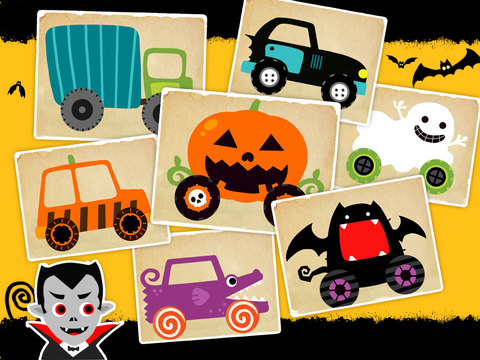
Labo Halloween Car-the kids I work with love the racing games so when I saw the Halloween Car app by Labo Lado, I had to have it.  I've used it with a few of the kids I work with and they really are loving it.  They get to choose from 12 different cars, several of them being Halloween themed (think bat, pumpkin and ghost).  They get to color it any way they want, add wheels and then add details and a character to make their car their very own.  Once they have completed designing it, they get to take it on a ride through different spooky racing routes.  
This app is great for working on improving graphomotor skills, encouraging creativity and visual motor/perceptual skills.  Also great for working on executive functioning skills, such as focus and attention and organizational skills.   
Stella and Sam Halloween Band-I've been a longtime fan of all things Stella and Sam by Zinc Roe Design since they are so interactive and work on so many occupational therapy goals.  If you haven't checked out their other apps, do yourself a favor and do it!  In this Halloween themed app, you get to join Stella and Sam in their band!  There are 6 different instruments to play.  You can change the sounds by moving the band members side to side or up and down.  If you look carefully, you will see bats, spiders and other characters floating around that you can interact with.  Great for preschoolers or young school-age children.  You can work on color recognition by having the kids hit the different colors when you ask them to.  As they get more familiar and comfortable with their colors, you can make this more complex by having them follow sequences.  For some kids, you might want to make them remember the order just by telling them and for others you may want to put out a visual for them to follow.  Kids will creating their own music while learning at the same time.  
Spooky Letters-I have a ton of great handwriting apps, but thought it would be fun to spice things up with this Halloween themed writing app by MadeByEducators.  In this app, children can practice writing upper and lower case letters, cursive letters, shapes/pictures and words.  What I really love about this particular handwriting app is that there is a big focus on phonics.  After practicing writing each letter, the kids then have to put letters in order for a word that starts with that letter or put together a simple puzzle that reveals what monster is hiding in the box.  For example, after you write the letter "K", a jumbled up word (key) comes up and they have to put them in order.  During the whole thing, the kids are hearing the letters being sounded out which is great for those who are struggling with learning how to read.
**one thing I noticed is that some of the letters that we typically start at the top (M and N for example), actually start at the bottom.  Could be confusing for some kids but there are a lot more positive things about this app that make it a good one to add to your handwriting app choices.

If you are concerned about using an iPad during therapy, keep in mind that there are a ton of ways to make it more therapeutic.  I also can't Here are a few examples of things you can do to make using the iPad more meaningful, whether it be at home or during your therapy sessions:
*use a stylus-many of the apps can be done using a stylus.  So even though the kids are absorbed in the app, they are working on developing a proper grasp.
*many of the kids I work with need to work on increasing their overall body strength, particularly upper body and neck/head.  Have them go on the net swing and play the apps.  
*if you work with groups of kids, almost any of these apps can be good for a small group setting.  They will have to compromise about colors for their cars, what to feed the monster, take turns playing instruments, etc.. There are a lot of great social opportunities available when using the iPad in a therapeutic setting. 

I would love to hear if any of you have some great Halloween or fall-themed apps that I should check out.  I like to take advantage of holidays and mix things up during my sessions.  Between the great arts and crafts activities, baking activities and the iPad apps, I have been rejuvenated the last couple of weeks during my sessions.  The kids are also having a great time and excited for new things at the gym.  So if you have any fun things to suggest to me or my readers, please share them!  I am always a click away and love hearing from you all!


Tuesday, 8 September 2015

If We Could Turn Back Time...and Just Play

In the last few months, I have been reading up a lot on play and how research is finding how important it is to social emotional development for children.  We have become so focused on teaching our children the ABCs and 123s, that we have ended up decreasing the amount of time they get to just play.  I know that there is lots of time during the school day for kids to "play" but it is often directed by the adults because kids are given a choice to play in one station or another.  There is often an adult guiding their play.  I can't tell you how many times I have walked into a classroom observation and seen kids on the outside of the group having to be brought in and directed how to "play" by one of the classroom team members.  Play, unfortunately, is something that has taken a backseat these days as we as a society place a greater importance on teaching our kids and making sure they have all the academic skills.  You don't hear parents bragging about that awesome block castle their kid build all by themselves, do you?  What you hear are things like "My 3 year old already knows how to write all their letters!" or "My 4 year old learned how to read!"  While these are both critical skills for every child to learn, they don't need to be taught at such a young age.  Leave that to their teachers and begin playing with your kids!

Why is play important?  There are endless reasons, but here are just a few:
*children are given the opportunity to practice both verbal and nonverbal communications skills by negotiating roles and gaining an understanding of other peoples feelings.
*they learn important social skills that they will need for the rest of their lives such as turn taking, sharing materials and waiting for their turn.
*play and physical activity has been linked to helping kids be more creative thinkers and have a better ability to connect with others.  They are better able to negotiate, share and resolve conflicts when given ample opportunity to play independent from their caregivers.
*play helps to improve fine motor skills.  Children who have been given lots of playground play opportunities are given the chance to hone their body strength and coordination skills which leads to improved fine motor skills.  It also helps them to build gross motor skills, improve self-control and modulation skills.
*play has been proven to relieve stress in children, especially as the academic demands begin to increase.  I always tell the parents I work with that what we expect from kids today is abnormal.  We are asking way more from them than is developmentally appropriate.  According to a poll of parents by Let's Play, 46% of the parents said that the focus on academics was one of their kids' biggest barriers to play.

The countless articles I have read have gotten me thinking a lot, especially as I watch my daughter grow and mature.  I have always been impressed how she has always been able to interact with her environment.  Not just the people in her environment, but the toys and objects as well.  Now, don't get me wrong.  I am not preaching, judging or trying to tell anyone what is right or wrong when it comes to play and the kinds of activities and toys we expose our children to.  My daughter is an expert when it comes to playing with and exploring an iPad.  Maybe it is a bad thing at times but it has helped motivate her to learn how to write letters, begin learning how to read and kept her from freaking out during some long car and plane rides.  I'm definitely guilty of buying those battery operated toys that she has seen on television (she's an commercial addict and MUST have everything she sees) because she "has to have them".  But what I love the most is that as much as she loves those things she sees on tv, she can play for hours with her little Maileg bunnies and mice I've been collecting for me...I mean her...since she was born.  She can play in her kitchen and cook for her daddy and me coming up with some of the most delicious meals.  When I would pick her up from school, she would run around with her friends without a care in the world playing tag and other kid games.  I know that even if she is exposed to too much television and screen time on the iPad, she has a vivid imagination, can sit and color and draw for long periods of time and socialize with her peers without me having to step in more than what any parent of a kindergartener expects to.

These articles have also gotten me thinking about my childhood and what I did outside of school.  I am one of four girls, my younger twin sisters being less than 2 years younger than me.  We would come home from school and not have to do homework and were forced to go out and play.  Even in the most awful of weather, we were outside.  My mom would pull the car out of the garage and we would ride our bikes, play games and just play.  In the fall, we were given rakes and made leaf mazes and homes.  In the winter, we were given shovels and made snowmen, threw ourselves in the snow and made snow angels and have snowball fights.  It didn't matter what season it was, my sisters and I were encouraged to just play and have fun.  In those moments, we learned how to fight, how to resolve our conflicts and how to compromise with each other.  It wasn't always clean and there were several times that our parents had to intervene, but I know that these opportunities to just play shaped us and our relationship as grownups.

These articles and focus on play has also gotten me to think about the toys we used to play with growing up.  They were so simple yet kept us focused and engaged for such a long time.  Most of them didn't require batteries, didn't make a lot of noise and could be shared with a sibling or friend and encourage social interactions, such as turn taking, compromise and being flexible.  These toys encouraged you to be creative and think outside of your comfort zone.

Here are some of the toys from when I was growing up that are still around today. They may have been modernized to some degree, but not too much.  They are still great toys and in my opinion, ones that we should be getting our kids:
Hula Hoop-do you know the Hula Hoop we know today was invented in 1958?  They are great for working on improving trunk control, motor coordination, focus and attention and increasing frustration tolerance.  Hoop Mamas, an Etsy based store, custom makes hula hoops in different sizes and colors!  A great gift for your those kids you know who love to hula hoop!
Sit N' Spin-the Sit N' Spin is still as awesome today as it was nearly 40 years ago.  They have upgraded the original one several times since its debut in the early 70s, but I am happy to see that they have a non-singing, non-lightup version available now.  The Sit N' Spin is great for working on bilateral coordination, modulation/regulation skills, building upper body strength and motor coordination skills.
Colorforms-Colorforms have been around for over 60 years and one of the oldest and best known toy brands.  These vinyl re-stickable playsets started off as basic shapes (you would put the shapes together to make pictures) and has evolved to popular characters from tv shows and movies.  I'm pretty sure I had a Strawberry Shortcake set way back in the day.  I use Colorforms in my therapy sessions and the kids love them.  Every time you play with them, it can be a little different.  They are great for working on fine motor skills such as grasping, visual motor and perceptual skills and improving language skills.
Wacky Wally-recently, my daughter and I were in a toy store and she found this sticky starfish that can "walk" down the wall.  She got the biggest kick out of it and would fall to the floor laughing as it clumsily made its way to the floor.  It totally brought me back to my childhood and how much fun I would have with my sisters and friends having Wacky Wally races.  It was the simplest of toys yet it provided endless entertainment.  I've actually used other kinds of sticky toys during my therapy sessions.  Sometimes I have them throw them at targets on the wall or mirrors which they love to do.  This simple and inexpensive toy is great for working on decreasing tactile defensiveness (because of it's sticky texture), upper body strength and motor coordination skills.
Snoopy Sno-Cone Maker-first introduced in 1979, the Snoopy Sno-Cone Maker was on every kids wish list growing up.  While things have evolved and we have the ability to make much more sophisticated cool treats, there is something about this sno-cone maker that just takes ice, juice and/or flavoring to make them yourself.  Great for working on bilateral coordination, increasing upper body strength, focus/attention and many other OT skills.  Also great to use with a small group of kids to work on improving social skills such as turn-taking, compromise and improving pragmatic language skills.
Connect 4-even though there are several versions out there now, the original game came out in 1974.  The 2 player game was easy to put together and was simple to play.  Choose a color and start putting the pieces into the board.  The first person to get four in a row, is the winner.  Great game for working on focus/attentional skills, improving executive functioning skills, eye-hand coordination, visual motor and perceptual skills.  Also a great game to play in a small social skills group.
Spirograph-this arts and crafts set has been around for over 50 years and kids today are still enjoying it.  Spirograph was originally designed by a mechanical engineer for use as a drafting tool.  The gears and wheels work together to create cool and colorful swirling designs.  There are now several versions to choose from, including a My Little Pony one that I think my daughter would lose her mind over!  For you traditionalists, no need to worry.  The original set is still available.
Great for working on bilateral coordination skills, improves eye-hand coordination, visual motor and visual perceptual skills and focus and attentional skills.  Also great for encouraging kids to be creative and think outside of the box.
Cats Cradle-I remember spending countless hours playing Cats Cradle with my friends and don't know why I haven't done this at work with my kids!  Using a long circular string, you can create a series of string figures.  This two-person game is great for working on improving fine motor skills, visual motor and perceptual skills, eye-hand coordination, executive functioning skills and many other occupational therapy skills.  I'm definitely going to get myself the book and re-learn how to play this game and start using it at home with my daughter and at work!
Card Games-a simple pack of cards can go a long way in entertaining kids.  I feel like each family has "their" card game.  My sisters and I used to play the game Spit all the time and my now 7 and 10 year old nieces are following in that tradition.  I've used cards to help reinforce number learning with some of the kids I work with.  I love this article by Today's Parent that has the directions to 10 family friendly card games.   
Jenga-did you know that Jenga was released in other countries before coming to North America in 1986?  I remember playing this game with my friends and family as a kid and as stressful as it was, it always ended up with everyone laughing!  After you stack the 54 blocks into a tower, you take blocks out and place them back on the top of the tower. The game continues until the tower falls.  This game is great for working on fine motor skills, eye-hand coordination, modulation and regulation skills, focus and attentional skills, motor planning and social skills.  I've actually taken a Jenga game and written questions on each block so each time the block is pulled, a player has to ask the other players social questions.  This can be a great ice breaker game for any social skills group!

These are just a very small handful of games and toys.....I could have gone on and on and on!  As it is, I have a wish list on Amazon.com a mile long on old toys and games I MUST have.  I would love to hear from you about your favorite toys or games growing up.  For you parents reading this post, is there any toy/game from your childhood that you play with your kids?  What about you therapists? do you have anything form your childhood that you use in your therapy sessions that the kids just can't get enough of?  I am only a click away and love hearing from you all!


Wednesday, 22 July 2015

Let's Get Cooking!

It's totally crazy to think about how quickly this summer is going.  I don't know about you, but even though we are having a lot of fun and doing lots of things with our own daughter, my husband and I are sometimes trying to figure out what to do with her.  We are getting to that point, especially these last few days, that it's so hot out that we don't even really have the motivation to go outside.  So even though there are several weeks left of summer, it is now it is time to get creative and keep us all from going to stir crazy.

One thing that brings me more joy than pretty much anything is baking.  It is something that connects me to my father and acts as my personal therapy.  As soon was Quinn was old enough, I started having her bake with me.  As a matter of fact, one of my favorite gifts for her was her first apron (thank you Carrie Cook!  Quinn still wears it when baking all these years later).  It started off simple and I would have her pour all the ingredients in for me.  As she got older and could be more involved, I'd let her do more.  The day I let her crack her own eggs was a pretty exciting day for her.  Baking with Quinn has been something that has not only been something we could do together to bond over, but has been a fun way to teach her new things.

Cooking and baking with your kids can be a wonderful activity, especially in air conditioning on these super hot days.  When parents are asking me for things to do over the summer to keep their kids up to speed with their occupational therapy goals, baking is one of the first things I suggest.  Not only is it fun, it can be tremendously therapeutic. Additionally, introducing kids to cooking/baking early on in life makes them more likely to take risks when eating and try new foods.  There are also a lot of ways to sneak in opportunities for learning when baking.  For example, if your child is working on learning their letters and numbers, they can make cookies using alphabet or number cookie cutters. If they need to work on building up strength, you can do it while stirring ingredients.

**before I begin the next half of my post, I am going to admit I am much more of a baker than a cooker.  So going forward, when I say baking, it represents both baking AND cooking***

Some of the therapeutic benefits of baking with your kids are:
Improve Upper Body and Hand Strength-baking is a great way to work on this skill in a fun and sneaky way.  Stirring the ingredients, especially as they start blending all together, can become increasingly difficult and require a lot of strength and endurance.  When baking for your family, I suggest that parents let their kids roll up their sleeves and mix with their hands instead of a spoon or a spatula....this really helps with building up the strength in those small muscles of the hands.
Improve Bilateral Coordination-baking is a great way to work on improving bilateral coordination because there are so many parts of this activity that require the use of two hands.  For example, when pouring the ingredients you need one hand to hold the measuring cup or spoon and the other pours the ingredients.  When mixing the ingredients together, it's essential that you hold the you hold the spoon or spatula with one hand and keep the bowl stable with the other one.  How about cracking an egg?  You need to hold the egg with one hand and keep the cup or bowl still with the other.
Improve Fine Motor Skills-do you have kids who need to work on improving cutting, grasping and other fine motor skills?  Baking is a great way to do that in a really fun way.  Need to work on cutting?  How about getting your kids to cut open the bag of chocolate chips?  If you have a ton of patience and time, you can use a pair of Zoo Sticks to put some of the smaller ingredients in (chocolate chips, pieces of fruit, etc.).  Even the simple task of pulling the paper off the butter is a great fine motor activity.
Improve Visual Motor/Visual Perceptual Skills-baking is a great way to work on improving visual skills.  When you are following a recipe, you have to be able to visually track between the recipe and the ingredients.  You need to be able to pour ingredients into a measuring cup or spoon and be able stop pouring them when they hit the line.
Improve Executive Functioning Skills-what I love about baking is that it is a great activity to work on improving higher level skills for older children.  Baking requires an incredible amount of focus and attention.  It requires one to be able to organize their ingredients, sequence and follow directions.  If you one doesn't (and I have lots of experience here) follow directions and focus carefully, you can end up with a mess of a project.  Baking is a great activity for older kids who need to work on improving their executive functioning skills and the best part is that much of the work can be hidden.
Improve Social Skills-baking is an incredibly social activity. Even though I am an occupational therapist and I tend to see kids on a 1:1 basis, I have also been lucky enough to spend a lot of my time working in social skills groups.  As a matter of fact, in September, I will be working with The Meeting House again as we begin our TMH Juniors group.  One of our program offerings will be a baking/cooking class once per month.  The social benefits of baking are endless and can be easily carried over at home with siblings and friends.  You can work on taking turns (pouring ingredients in), work on compromise and working as a team to complete a final project.  Once a cooking project is finished, there is a tremendous social opportunity to take advantage of.  You can set up a table or a picnic blanket and let the kids have conversations about what is happening in their lives.  If you have kids who have difficulty with conversation, you can throw a pile of conversation cards out in the middle of the table for them to reach out for when there is a lull in conversation.

There are a lot of fun and simple baking and cooking activities that you can do with your children...some that don't even require oven or heat!  Just keep in mind, when cooking with children, you will need patience and extra time.  Kids will ask a lot of questions, make a mess and may even lose their attention part way through your activity.  One thing to do in order to prevent that from happening is set up all the materials before you call your kids in....have your ingredients out, eggs cracked and in a cup, measuring spoons and cups ready, etc..  As children have more success with a cooking activity, you can start to add on responsibilities such as having them take out the ingredients.
Here are a few ideas for you to try with your kids, either at home or at work. I've tried them all and they have been a huge hit!

Zipsicle-I saw these when in Bed, Bath and Beyond a few weeks ago and had to try them.  Who doesn't love a refreshing ice-pop?  How about making your own with your kids?  These little pouches are perfectly designed for making your ice pops.  If you go here, you will find a bunch of tasty and easy recipes you can follow to make your very own ice pops.  The best part, is that you can avoid artificial flavors and colors, which so many of the kids I work with are unable to eat, and add lots of fruits and other healthy ingredients.  
Zoku-this is another fun way to make your own ice pops at home.  I wrote out the Zoku ice pop maker about two years (check out that post here) and since then, they have expanded their line.  They still have their original pop maker, but now have smaller ones that don't take up as much room in your freezer.  They also have molds that are in the shape of fish, people and rockets, which might make your little ones more willing to try a new flavor. You can follow one of their recipes or make something of your own.  
Rainbow Fruit Kabobs-another activity that doesn't require the use of an oven or heat.  I love the idea of fruit kabobs and have actually made these with many of my kids when I was running social skills groups.  This activity is great because it can encourage your child to try new fruits.  It works on building fine motor, visual motor/perceptual and bilateral coordination skills.  For younger children who are just beginning to learn their colors, it's a fun way to reinforce it for them.  It's also nice to work on improving organizational and sequencing skills for older children who are struggling with both of these things.  Lastly, this is a simple enough of an activity that you can do it in small groups and encourage conversation, cooperation and team work.
Alphabet Cookies-I have always found that if you hide the work in learning, kids are more likely to hold onto the information.  I have always had a set of alphabet cookie cutters in my office to use with playdough and the kids really love it.  At home, you can take those same cookie cutters and make cookies instead.  If you are motivated, you can make your dough from scratch but if you want to
make it simple and fast, buy the rolls of sugar or chocolate chip dough at the store....the end product is the same.  There are so many opportunities to talk about the letters during this activity...you can have them look through the pile to find a certain letter and talk about words that start with certain letters.  Once they are all baked (and cooled), you can have children put them in order.  And if you want to make it really fun and therapeutic, you can decorate the cookies after using icing, sprinkles and other fun decorations.

These are just a few ideas to get you started but really, you can make any recipe a good recipe for kids.  I know that my daughter just loves being part of the process.  It can be as simple as pouring the cheese, butter and milk into the macaroni when making mac and cheese or as complicated as shredding cheese with a grater (kid friendly of course) for meals.  In addition to all of the skills that can be worked on while baking or cooking, it's a great source of pride for a child to be able to tell people that they helped make whatever they are eating.

Do you have a favorite recipe or cooking activity that you do with your child?  It would be fun to be able to put together a list of things that you have been successful with and share them with each other.  While I am an avid baker, I am always looking for new and tasty recipes to try with Quinn.  I'm always a click away and love hearing from you all.

Stay cool and fun baking with your kids.  Who knows, if you start your kids off early in the kitchen, maybe they will be the next top chef!

Wednesday, 24 June 2015

Put Your Arms In The Air Like You Just Don't Care!

In an effort to make this blog more informative for my readers, I am going to begin sharing interesting and helpful blog posts that I stumble upon.  For some reason, it hadn't occurred to me until just today that if I found these articles helpful, that my readers would also feel the same way.  The internet is a wonderful resource, especially when working with children. There is a ridiculous (in the best way possible) amount of information out there to be shared with everyone.  However,trying to sift through all the information can be exhausting and time-consuming.  So thanks to Kristin, here is my first article share blog post!

Today, the mom of one of my clients sent me a great article that talked about the importance of working on a vertical surface.  It was written by Lauren Drobjnak, a pediatric therapist and mother who began The Inspired Treehouse with her colleagues in order to share playful activities for children that promote development and wellness.  Their belief is that if kids are given a little help, they can build strong and healthy bodies and minds through play and exploration.  Do yourself a favor and check out and subscribe to their blog here...I promise you won't be disappointed by their emails.

Motor Skills and More!  Working on a Vertical Surface is a quick, easy and informative read about
what can be achieved by working on a vertical surface.  Some of you may be asking "What is a vertical surface!?!?".  Simply put, a vertical surface is a chalkboard or an easel... a surface that is on an incline that requires a child to have to raise their arms in order to write on it.  It is something that requires upper body strength and endurance.  When I was growing up, there was a chalkboard in every classroom I entered.  Daily, I was asked to go up and answer a math question or write the answer to a teacher's question on that board.  I never would have imagined that that simple task, something that seems so "normal" to so many of us, would be something that isn't really part of a kid's school routine these days.  Nowadays, we have the SmartBoard or a dry erase board in classrooms.  You may not sneeze because of all the dust from the chalk, but it will serve the same purpose in writing on a raised surface and sharing information with your classmates.

Whenever I am asked by parents about what can be done at home to help support our work in therapy, one of the first things I suggest is to get an easel.  Living in NYC, some parents worry that they don't have the space for a large and bulky object...space is limited and we all know that kids come needing a lot of things to keep them busy!  For those parents, I suggest that they get a chalkboard or a dry erase board that can be mounted to the back of a door or the wall of a bedroom.

Working on a vertical surface can be beneficial for children of all ages, especially those who need to work on increasing core strength and postural stability.  Depending on the height of the working surface, you can have a child kneel, stand or sit on a therapy ball to draw, paint or write.  Another great thing about working on the vertical is that it is ideal for working on improving bilateral coordination skills.  I have kids hold a piece of paper up with one hand while using their other to hold the writing instrument.  This article talks about playing with stencils to also work on developing skills.  Please click here to learn about all the other benefits of working on the vertical that Lauren Drobjnak talks about.  

Fort those of you wondering what kind of vertical surfaces would be good for you and your home, I have provided a few suggestions below.
Chalkboard Wallie (Extra Large)-these extra large panels can easily be repositioned and placed wherever is most convenient/space allows.  Hang on the refrigerator, the back of a door or in a playroom.  I have one of their smaller versions hanging in my kitchen and my daughter has loved drawing pictures and practicing writing her letters on it.  They are easy to clean and can be used with any kind of chalk.  Be sure to hang them up in a way that makes your child have to have their arms extended in order to work on increasing upper body strength.

Dry Erase Board-there are a lot of dry erase boards to choose from that will work on all of the things mentioned in Motor Skills and More!  Working on a Vertical Surface.  I have always been partial to this one by The Container Store simply because it takes up no room at all and is easy to hang up.  It can go on the back of a door, inside a closet or wherever you happen to have the space for.   Also, another important thing, it is very reasonably priced!

Artist's Portrait Easel-if you happen to have the real estate in your apartment for a real deal easel, don't look any further than this one by Land Of Nod.  When my mother asked me what she could get my daughter for a Christmas gift one year, this was the one and only thing that came to mind.  It's been a favorite of Quinn's for years and has gotten so much use since it was gifted to her.  My favorite thing about this easel is that while it is large, it isn't bulky.  It can be folded up and set against a wall without taking up too much space.  Another great feature is that it is double-sided and can be used for many things.  One side has a chalkboard while the other has a dry-erase board.  That's not all...at the top you will find a place to hold a roll of paper for drawing with crayons or markers or paintbrush or finger-painting.  A bonus factor.....it's modern and sleek looking.

Backpack Slant Board-Fun and Function, one of my favorite therapeutic catalogues, has a variety of slant boards to choose from.  I recommend slant boards for many of the older kids I work with for homework time.  Slant boards are great because they don't take up a lot of room.  This one I have
suggested is even better because it can easily fold up and fit into a child's backpack making it easy for them to transport back and forth with them.  The most important thing about using a slant board for kids with graphomotor difficulties is that the design of a slant board automatically puts the wrist in an extended position, thus encouraging hand stabilization for greater ease in controlling writing instruments.  I don't only use this for handwriting/grasphomotor activities...when using an iPad in therapy, I will put the iPad on it to accomplish the same thing.

Thank you to The Inspired Treehouse for this wonderful and informative article!  I hope you all find this as helpful as I did!

Friday, 19 June 2015

Coloring...Not Just For Kids!

I wrote a long time about about coloring books and often refer to my favorites in some of my posts.  I
love having a good selection of coloring and activity books in my office and at home.  One thing that I have discovered is that coloring isn't just for kids these days.  I will often join the kids I work with or my own daughter when she is coloring.  I do this for several reasons:
*if I am engaged in a coloring activity, I find that the kids will color for longer which ends up building up their grasp strength and endurance.  It also helps on increasing a child's attention span
*I will often mess up or ask a child for their suggestions on what colors I should use to help them understand that their pictures don't have to be perfect or that they shouldn't get too frustrated when coloring
*I find coloring to be one of the most calming and organizing activities.  Not just for kids, but for anyone.  

In this post, I am not going to focus just on kids coloring/activity books, but also ones that are good for older kids and for adults who may love to color.  Coloring with your kids is a great way to stimulate conversation and imagination skills.  It is a wonderful way to build confidence and self-esteem...when a child completes a picture that they have worked really hard on, they feel really good about themselves and want to show it off to their people.  There is no greater source of pride for my own daughter when someone compliments her on her work and then hangs it up.

Some of my favorite coloring and activity books right now are the following:
Secret Garden and Enchanted Forest-these two books by Johanna Basford are more than just coloring books.  They are also coloring adventures that take you on a journey through a beautiful garden and an enchanted forest to discover what is in the magical castle.  The pictures are all in black and white and have so many little details to color in.  In addition to coloring some of the most magnificently drawn pictures, you have to find objects hidden within each picture.  I also like that some of the pages have mazes to go through and pictures to complete.
While these books are most definitely for older children, they are definitely something that could be done together with your child.  Having them look at the pictures and tell a story based on what they see is great for building up their language and imagination skills.  You can play a game of I Spy while looking at the pictures to find some of those hidden objects.  I first discovered these beautiful books when shopping at my local toy store, Norman and Jules, but you can also find them at the bigger bookstores and other speciality toy/bookstores.

Color Me Calm-this is a book that was designed for busy and crazed adults.  At a time where life gets busier and more complicated each day, we find ourselves to become more stressed and overstimulated by work and family obligations.  Created by art therapist Lacy Mucklow and artist Angela Porter, Color Me Calm has about 100 different coloring templates that were created specifically to get a person to color themselves to a calmer and more relaxed state of being.  The book is broken down into seven therapeutically-themed chapters including Mandalas, Water Scenes, Wooded Scenes, Geometric Patterns, Flora and Fauna, Natural Patterns and Spirituality. The intention of the book is for adults to put pencil to paper and get themselves into a state of creativity and relaxation.  Some of the pictures could be appropriate for younger children, but this is definitely intended for older children and adults.


Daydream Doodles-I've been looking through the shelves at Barnes and Noble and other bookstores non-stop lately trying to find new coloring and activity books for not only the kids I work with, but for my own daughter who has officially turned into one of those kids who can't stop drawing and coloring.  While I love to see her imagination come to life on paper, it isn't always so easy for her and she needs some jumping off ideas.  Throughout this book, there are several different kinds of activities.  You can color in pictures, complete different kinds of pictures or draw your own patterns on objects.  This coloring book is definitely more appropriate for older children (they suggest 6 and older).  In addition to working on improving visual motor and visual perceptual skills, it is great for working on creative thinking and imagination skills.  I like that you can also work on language skills while the kids are completing their pictures.  You can also work on improving executive functioning skills be encouraging them to talk about what they are going to draw, how they are going to do it, etc..

Usborne Big Book of Drawing, Doodling and Colouring-I am a huge fan of all the Usborne activity books.  They have a wide range of coloring and drawing books that will spark the imagination of children.  This book is especially awesome because it has a wide range of activities in one book.  There are pictures and patterns to color in and complete, various scenes for children to color in and add their own details and pages that will teach your child how to draw things step-by-step.  The book is filled with a ton of modern and stylish pictures ranging from monsters, animals and food.  I have found that many of my kids, even those who typically resist any kid of drawing/coloring activities, love looking through this book and finding the "right" picture for them.   My favorite pages are those that teach kids how to draw different animals, people and objects step-by-step.  The directions are easy to follow but also leave plenty of room for kids to use their imagination and add their own details to pictures.  This book promises to be fun not only for your children, but for the adults who want to color and draw with them!

Here are a few handwriting/coloring tips to keep in mind when coloring with your children:
*always encourage a child to hold a writing instrument properly.  Broken crayons or short colored pencils are an easy way to get a child to hold a writing instrument with a tripod-like grasp. Some of my favorites are the Faber-Castell Jumbo Triangular Colored Pencils, Flip Crayons by Handwriting Without Tears and the Staedtler Triplus Fineliner Markers.
*if you are working on increasing upper body strength, have children color on an elevated surface like an easel or tape the paper to a wall.
*let kids do what they want with colors....let them choose whatever color they want for what they are doing without telling them what they should do.  Coloring should be an activity that allows kids to express themselves and expand their imagination skills.  They want to color an elephant pink...go for it!
*try and encourage a child to stay in the lines when coloring, but don't make a big deal about it if they don't.
*work on building language skills by having children tell you a story about their picture.  Encourage them to elaborate and talk about the details by asking them meaningful questions.

With summer just a few days away, I'm finding that parents are asking me more about what they can do for their children to keep working on their fine motor and visual skills while they are taking a break from therapy.  Coloring, drawing and activity books are a great and fun way for kids to keep working on skills that have been addressed in therapy during the school year.  So many parents want to be more involved in their child's therapy but complain that the kids won't "work" for them.  Coloring is a great way to hide the therapy piece.

The books I suggested in this post are definitely geared more towards older kids, but there are many other books out there for younger kids.  If you want to read about books that are better suited for younger/pre-school aged children, check out this post here.

Do you have any great coloring or activity books that I should add to my library?  I'm looking forward to nights of coloring with my little girl this summer and would love to test out some new ones.  I am always a click away and love hearing from you all.

Friday, 22 May 2015

Summer hAPPiness

It seems like just yesterday I was writing about the school year beginning.  Somehow, this year has
gone by faster than seems real and I am doing summer scheduling and helping families who will be out of the city for the summer come up with activities to keep their kids busy and learning.  I have several kids on my caseload who will take the summer off but need to remain a bit focused on what we have been working on in occupational therapy all year so when they come back we don't have to spend too much time reviewing things.

Every year, parents ask me what they can do with their kids over the summer.  They don't want to spend too much time focusing on academics but they also want to make sure that their kids don't lose any of the skills that they have worked so hard on acquiring over the course of the year.  So many of the families I work with spend a lot of time traveling so I like to give them a list of apps that they can work on while in the car, planes, etc..

It's a proven fact that kids are motivated by an iPad.  I can't tell you the number of things I have been able to accomplish and get kids to work on when presented to them in app form first.  For those of you who read my blog, you will know that I don't believe that the iPad is the end all and be all of things.  When used in conjunction with more hands-on activities, it can be a tremendously motivating tool.  There are so many great apps out there that can work on a ton of occupational therapy skills, especially handwriting and visual motor/perceptual skills.  I highly recommend setting up a folder on an iPad for each of your kids with the apps that are best for them.  I think it is also important to note that using an iPad can not only be good for learning, but can be good for encouraging social skills and language development.  Kids should always be supervised when using the iPad...not only to make sure that what they are playing is appropriate for them but also so adults can step in and encourage kids to be social if they are using it together.

Whenever appropriate, I have my kids use a stylus when using the iPad.  This helps on working on fine motor skills, especially proper grasping skills when using writing instruments.  My two favorites are this crayon stylus by Fred & Friends and this mini stylus pen by Kikkerland.  Both are the perfect size for little hands!

Here are a just a few of my favorite apps and a brief description of what they will work on:

LetterSchool-one of my favorite and definitely my go-to app for handwriting.  Whether you want to begin working on teaching children how to write their letters or if you want to review what they already know, this is the best app out there.  It comes with three options:  uppercase, lowercase and numbers.  There are two levels of play for lots of practice.  For each letter and number, you work through 3 games (tap, trace and write) in order to earn stars.  Once you have completed both the silver and gold levels of play, you can then unlock the opportunity to do free-form writing.
Toonia Differences-I blogged about this awesome app by Toonia a couple of weeks ago here.  This app is similar to those Spot the Differences games you have may have played at some point.  You have two pictures side by side that are almost exactly the same and you have to find the 8 things that are different about the picture.  This is a great app for working on improving visual perceptual skills, especially visual scanning and visual attention.  You can read more about this app here.
Toonia Storymaker-another great app by Toonia.  This one is a fun and educational app that encourages children to be the author of their own story.  They are allowed to choose their own characters and scenes to tell their own story.  They can change colors, shapes, size, posture and emotions while creating their story.  This app encourages creative thinking, sequencing, organization and focus and attention.
Dexteria Jr.-I've had this app on my list of favorites for a long time.  This occupational therapist created app is a set of hand and finger exercises that help develop fine motor skills and work on getting kids reading for handwriting.  It's great for children as young as 2 years old and can be motivating enough for those as old as 8-10.  There are 3 games with multiple levels of play in each game.  Squish the Squash works on pointing skills; I am pretty strict with the kids about using their pointer finger during this game.  Pinch the pepper works on developing in-hand manipulation skills, specifically pinching using the thumb and pointer finger.  The last is game is Trace & Erase and kids work on graphomotor skills by tracing lots of different lines and shapes.  Once they are done tracing, they have to erase the lines and then the built-in camera will take a silly picture of the kids.  It's a simple game that works on visual motor and visual perceptual skills as well as improving focus, attention and concentration.
Pepi Play-it's hard to choose just one of the apps by Pepi Play.  I have all of their apps and they are big favorites with the kids I work with.  They are incredibly interactive and within each app, there are several games for them to play with.  Right now, my kids are really loving Pepi Bath 2 and Pepi Doctor.  Pepi Bath 2 has 6 different bathroom or cleaning situations.  It's the kid's job to help their character (3 to choose from) get all cleaned up:  they may help them go to the bathroom, get cleaned in the bathtub or get their clothes cleaned after some dirty play!  In Pepi Doctor, the kids help their character "get better"; they may need to help them get better from a cold, after falling off their bike or scooter (I ask the kids to tell me what they think happened to the kid and how they got hurt) and getting lots of scrapes and dealing with an aching tooth.  These apps are just two of the several that you and your kids will love playing together!
Tiggly-Tiggly has created two interactive games and several apps that work on fine motor, visual motor/perceptual, eye-hand coordination, early literacy and math skills.  Tiggly Shapes are rubberized shapes (circle, square, triangle and star) that children can use for learning and play with three different Tiggly apps.  The shapes have a soft plastic cover and silicon touch points that interact with the iPad screen.  They are incredibly durable and can withstand crazy toddlers but gentle enough that they are safe for the iPad screen.  Read more about Tiggly Shapes here and find out all therapeutic fun your kid will have with them.  You can read more about TigglyMath in an early blog post here.  Rumor has it that Tiggly will be releasing a third learning system next week....just in time for the summer!  I can't wait to see what they have in store for all of us.  It's sure to be both educational and fun!
Endless Alphabet/Endless Numbers-Originator Kids is another wonderful studio creating fabulous apps for kids.  My two favorite are Endless Alphabet and Endless Numbers.  Endless Alphabet is a fun way for kids to get ready for early reading by being introduced to new words.  Kids have to match the letters of the word and then get to watch a short little video with some really cute monsters once the letters are all placed in the right spot.  Endless Numbers is a really fun way for kids to learn numbers, sequences and quantity.  It is incredibly interactive and fun so the kids don't even realize that there is a tremendous amount of learning going on at the same time.  These are just two of the great apps by Originator.  Be sure to check out all the others, especially the Mr. and Mrs. Potato Head Create and Play apps!

Bugs and Buttons /Bugs and Bubbles/Bugs and Numbers-Little Bit Studios may be one of my favorite app designers for children.  First of all, the games are fun and educational at the same time.  Each app comes with 18 different games which means that your kids can be entertained for a really long time.  The likelihood of them getting bored quickly is pretty slim which leads to lots of learning as the explore all the mini games.  Check out this blog post here that talks about just how amazing Bugs and Buttons (original and Bugs and Buttons 2).  If you want a real bang for your buck, then I highly recommend any and all of the apps by Little Bit Studios!
Avokiddo Apps-I wrote about this amazing company extensively in this post from March 27th.  So far, there are 5 different apps to choose from and they work on a variety of skills ranging from learning the letters of the alphabet to recognizing emotions to problem solving and several executive functioning skills.  The graphics are just amazing, the music is soothing and because of that, the kids I work with are totally motivated to play, explore and learn when using them.  I know when apps are really amazing when the kids I work with constantly ask for them and that is what happens with all of the apps by Avokiddo!

So, these are just a handful of the many apps I would recommend for summer learning.  As I was going through my iPad that is chock full of wonderful apps, I had a hard time choosing which ones to share with you all.  I ended up picking ones that kids are most likely to be independent with....they won't have to ask their grownups for too much help.  I also chose ones that I thought would be good for kids to play together in order to promote important social skills like turn-taking, compromise and conversation skills.

I would love to hear from any of you with some of your favorite apps.  If you have specific questions about apps that would be good for your children or ones that would work on specific goals, I would be more than happy to help you find the perfect ones.  I am always a click away and love helping parents and professionals identity apps that are better than others.  It can be a daunting experience going through the thousands and thousands of apps out there and since I have done so much research, let me be the one to help you as you figure out what would be best for your child.

Friday, 17 April 2015

Spring Has Sprung!


After what seems like the longest winter ever, spring has finally arrived in my corner of the world (Park Slope in Brooklyn, New York).  Flowers are blooming, windows are open more than closed and there is no sign of snow or winter anywhere.  Don't get me wrong...I love winter and all that comes with it.  But when March and April roll around, winter gets gross in New York City.  The snow is dirty and when it finally melts, there is so much gross stuff on the sidewalks that you want to walk around with your eyes closed.  So the fact there are flowers growing and birds chirping is totally welcome and exciting for me.

As an occupational therapist, there are a lot of exciting things that can happen therapeutically once the warmer weather arrives.  Parents are always asking me for things that they can do with their children to get them outside, get them moving and get them away from the television and other electronics that tend to be used to entertain our kids during the colder months.  I typically see a huge jump in skills with the kids I work with this time of the year because they are spending more time outdoors in the park or at the playground.  They are watching the big kids do things and they want to try and be just like them.  After months of therapy and boosting their confidence in their skills, kids who were once timid about taking risks at the playground are trying things they couldn't do before.  They are spending more time socializing with other kids and less time indoors so you tend to see a huge boost in their language skills as well.

Below, you will find a handful of activities that I suggest to parents to try with their kids in order for them to carryover some of the things we are working on in our sessions.  In order for kids to really learn skills, they need to be able to generalize them in different environments.  All of the activities will work on improving fine motor, gross motor and sensory processing skills.  They also can help in developing improved language and social skills.  Most importantly, they are guaranteed to be lots of fun!

Grow a Garden-in NYC, we don't always have the luxury of having a lot of space for such things.  With that said, my husband and I have found a way to get our 5 year old daughter into gardening in the last couple of years.  We are fortunate to have a garden in front of our brownstone and can really garden with her and it has been such a great experience for her.  If you don't have the outdoor space, you can get a couple of clay pots and have your kids grow herbs or flowers that don't require a lot of sunshine to grow.  Gardening is good for so many occupational therapy related goals from the moment you pick out the seeds to that magical moment when the flowers actually bloom.  Have kids fill up pots with soil using kid sized gardening tools.  This is great for working on building upper body strength, bilateral coordination and improving eye-hand coordination.  If you have a child who presents with tactile defensive behaviors, encourage them to use their hands to put the soil into the pot to work on that.  Gardening also teaches kids responsibility and gives them an opportunity to have a "job" every day.  Use a spray bottle to water your plants every day; this will work on increasing grasp strength and bilateral coordination skills.  Check out this adorable Garden Tote with tools perfectly sized for your little ones.

Ride a Scooter-in the winter, it's easier to get from place to place by throwing your kid in the stroller and not having to worry about them getting cold or slipping on the ice.  Now that it is nicer out, make sure you leave enough time in your day to allow your kids to get themselves to places on their own two feet.  Whether it be walking or scooting, getting your kids moving is key.  My favorite is the Mini Micro Kick scooter as I have found that it is light weight and easy for the kids I work with to use.  Even the kids on my caseload who have difficulties with balance, coordination and motor planning have success with this scooter.  So many parents come to me and tell me that the hardest time of their child's day is starting the school day.  Oftentimes, I find that kids are rushed through their morning routines, thrown into their strollers so they can be brought to school on time and then are thrown into the morning craziness and get overwhelmed and have difficulty.  When possible, I suggest to parents that they let their kids walk part of the way.  Even better, let them scoot the whole way.  It provides them with an incredible amount of organizing input to their sensory system.  The foot to pavement action gives them a ton of deep proprioceptive input that helps kids to be more organized and ready for a great day at school.
**one of the biggest complaints I get from parents about getting their kids to use a scooter is that they don't like the helmets and how they feel.  Take your kid to the store with you and have them try on helmets and let them pick which one they want.  Kids are way more likely to wear a helmet if they feel like it's one that they really like!

Chalk It Up!-one of my favorite things about the warmer weather is coming home at the end of the work day and seeing my own daughter outside drawing with chalk in front of our apartment.  She has learned how to write her name, draw pictures of people and so many other great things.  Writing with chalk is a great activity and can really be most enjoyed during this beautiful spring weather.  There are so many chalk choices these days:  think, thick, one colored or rainbow, egg or square shaped.  Keep in mind that using thinner chalk will most resemble a writing instrument in turn encouraging a proper grasp when using writing instruments.  If you can, have your kids draw on an elevated surface to work on increasing upper extremity strength.  If you don't have a driveway or a place in front of your apartment, grab the chalk and go to the playground.
You can make this a social experience by gathering a few kids together and having them make pictures together.  For example, draw a picture of a person and have each kid add their how part to complete the person. Or play a game of tic-tac-toe or hangman.  You can work on letter recognition, executive functioning and social skills at the same time!  If you have the space, you can have your kids draw a hopscotch board so they can work on improving gross motor skills too!

Bubblerama!-I don't know what it is, but kids and bubbles go together like bread and butter.  They just love blowing them, chasing them, catching and popping them!  A fun thing you can do with your kids is make your own bubbles.  Sure, you can go out and buy bubbles anywhere, but making them can be really fun and is really easy.  It is also great for working on a lot of occupational therapy goals in such a fun way that your kids don't even realize that they are working.  For example, you can work on improving bilateral coordination (holding bowl while pouring ingredients in and stirring all the ingredients together), increasing upper body strength (stirring the ingredients) and working on improving executive functioning skills like focus, attention and organizational skills.  For older kids, you can give them a list of all the supplies needed for the activity and have them gather them before beginning.  You can also write out the steps on a piece of paper, cut them into strips and have the kids put the directions in the proper order before beginning the activity.

To make your own bubbles, check out this recipe:
6 cups water (you can use tap but distilled is better)
1/2 cup blue Dawn dish detergent
1/2 cup corn starch
1 tablespoon baking POWDER
1 tablespoon glycerine

Dissolve the cornstarch in the water, stirring really well.  Once the cornstarch is completely dissolved, gently stir in the remaining ingredients (in no particular order) trying to not make too much froth.  Let the mixture sit for at least an hour, stirring occasionally if you see that the cornstarch is settling to the bottom.   Don't get discouraged if your first few bubbles don't come out too great...the mixture gets better after a few uses.

You can use bubble wands and blow bubbles (great for improving oral motor strength) or you can make your own super big bubble wand using straws and yarn (you need your yarn to measure about 6 to 8 times the length of a straw).  Take the yarn and string it through the straws, tie a knot and you have your bubble wand.  You can take your bubble solution and put it in a big bucket and start making giant bubbles!  Guaranteed fun for kids of all ages!


These are just a handful of fun and simple activities that you can do with your kids now that the weather is nicer.  I have chosen activities that can be done whether you live in the city or in the country...they just may need to be adapted based on what kind of space you have.  What are you most excited about doing with your kids now that spring is actually here?  Please feel free to share your fun outdoor activities with me and my readers.  I'm just a click away and love hearing from each and ever one of you!   I am looking forward to a fun-filled outdoor weekend with my own family and wish you all a very happy and warm weekend!