 | |
|---|---|
| Item Name | Anno 2205 |
| Price | Rp30.000 |
| System Reqruirement | Minimum:
|
| Available Stock | Ready |
| Trailer |
Thursday, 5 November 2015
Anno 2205

Monday, 2 November 2015
Oh The Weather Outside Is Frightful, But Play Inside Can Be Delightful!
 I have a lot of memories of growing up and the fun things I did with my sisters. We had a massive garage and no matter what the weather was, we would be outside in some way. She would pull the car out into the driveway so we could ride our bikes or play games in that garage. During the fall, we would be given rakes and make mazes or homes with our piles of leaves. We were encouraged to play, be creative and have fun. My husband and I have worked hard in making sure our daughter has a life where she is encouraged to do the same things. Even though we live in New York City, we have found ways to make sure these things happen. We build snowmen in front of our Brooklyn brownstone. We walk through the park and collect leaves and acorns. With the change in seasons comes a whole new level of creativity in order to keep our little one busy and excited!
I have a lot of memories of growing up and the fun things I did with my sisters. We had a massive garage and no matter what the weather was, we would be outside in some way. She would pull the car out into the driveway so we could ride our bikes or play games in that garage. During the fall, we would be given rakes and make mazes or homes with our piles of leaves. We were encouraged to play, be creative and have fun. My husband and I have worked hard in making sure our daughter has a life where she is encouraged to do the same things. Even though we live in New York City, we have found ways to make sure these things happen. We build snowmen in front of our Brooklyn brownstone. We walk through the park and collect leaves and acorns.
Baking
 Homemade Slime-I've always loved this science project. Most of us have made homemade playdough (which is also a really fun thing to do on an inside kind of day) at some point in our lives but there is something really fun about the slime and what I like most about it is that there is no cooking involved with it. I actually just made this last week for Halloween with my little friends at The Meeting House. We had the kids put googley eyes and spiders in their mixture and then they had to dig them out which is great for working on building grasp strength and fine motor skills. Using glue, water, food coloring and Borax (the powder kind that you can find near the detergents in grocery stores or some bodegas). Kids have the best time watching this liquid concoction turn into a blob of fun that they get to play around with.
These are just a couple of science activities you can do with your kids but there are hundreds more out there. Check out these websites for more ideas:
 It seems simple, but building toys can take up hours and hours of a day that has to be spent inside. Encourage your kids to dump out all their blocks and other building toys and mix and match them to make something amazing. Who says that Legos can't be used with MagnaTiles? The more you have, the larger and more creative your kids can be as they are building. If you want to wild, give them a bunch of characters and have them come up with stories with their siblings or friends. You can have them practice and then have them put on a show you can record and share with people. Don't worry about making a mess...that's easy enough to clean up later on!
Some of my favorite building toys are:
 For some of you, it might be pulling out those kid-friendly video game systems you have and letting them get some action. I appreciate that not everyone is into video games, but While I know not everyone believes in video games for their kids, there are several systems out there now that provide your children with more physically active gaming opportunities. For example, the Nintendo Wii has all kinds of fun sports related games like baseball, bowling and golf. My nieces are big fans of the Just Dance and SingStar games. The nice thing about all of these games are that you have to be on your feet, you have to move your body and you have to focus and attend to what is on the screen. For kids who may struggle with focus and attention, this could be a really fun way to work on this skill. In addition, all of these kinds of video games are great for working on improving motor planning, eye-hand coordination and visual perceptual skills.
Baking
One of my daughter's favorite activities to do with me is to bake. We keep it simple and something that she can be actively involved with the entire time. Baking can be something that can be done with just one child or a small group of kids. I love using baking as a tool to improve social skills. Here are some of our favorites right now:


Pizza-we are partial to using real pizza dough when we make our pizza, but you can also make pizza bagels and english muffin pizzas if you want to simplify things a bit. Kids can be fairly independent in the whole process starting at kneading and flattening the dough to putting the sauce and cheese on. If you have an older child, you can have them cut toppings like mushrooms, peppers or tear basil. Making pizza is a great OT activity because you can work on so many skills including improving bilateral coordination, increase upper body and fine motor strength and executive functioning skills.
If you want to make this project last a little longer, you can read Pete's A Pizza, a great board book by William Steig. You can read it to them while the pizza is cooking and cooling off before eating it!
Cookies and Brownies-we happen to be a family who has a pretty big sweet tooth and baking cookies and brownies is one of our favorite things to do, especially when we are stuck inside for one reason or another. If you aren't into making cookies from scratch, you can get the pre-made dough. Have the kids either slice the cookies or rip off a piece of the dough and roll them into balls. With sugar cookies, they can do the same thing and decorate them with sprinkles or candies. This whole activity is great for working on bilateral coordination, increasing upper body/fine motor strength and executive functioning skills.
Arts and Crafts
I happen to live in a neighborhood that offers a ton of great rainy day craft places. Our personal favorite is Hiho Batik, a DIY batik studio where you can make shirts, bags and other great items. What I love about it is that you are actually making something that you can use. However, most people aren't as lucky as we are to live in such a neighborhood so they have to find things that they can do at home. While people want to keep their kids entertained, they don't want to get involved in something too time consuming or messy. You also want to do things that your kids can do mostly on their own. Here are a couple of simple but fun activities you can do with your kids.
Superhero Mask-this can be a simple and very fun activity to do with your kids. Using felt and a glue gun, your child can express their personality through their masks. I've done this before where I
 cut out different shaped eye masks and then a bunch of shapes that they can glue on. For older kids, they can be in charge of cutting out all the shapes.

Superhero Cape-I LOVE this easy DIY superhero cape and can't wait to try this with some of my kids at work. All you need is a large t-shirt (the larger the better so it can really flow like a cape), felt, scissors and glue. Kids can make a cape with their initial, their favorite superhero log or whatever else they want to make this speak to what kind of superhero they are. For step-by-step instructions, check out this link.
Arts and crafts should be fun and exciting for kids. It should not be stressful or make them feel like they have to follow a bunch of rules. It should be a time for them to be creative and to express themselves and let their personality shine through.
Crafts are also a great way to work on improving fine motor, visual motor/perceptual and executive functioning skills. Carefully choose the writing instruments you provide your child with. If they have an immature pencil grip, you should present broken crayons or short pencils. If your child has a weak grip and tires easily when coloring or drawing, be sure to use markers as they require less strength
Crafts are also a great way to work on improving fine motor, visual motor/perceptual and executive functioning skills. Carefully choose the writing instruments you provide your child with. If they have an immature pencil grip, you should present broken crayons or short pencils. If your child has a weak grip and tires easily when coloring or drawing, be sure to use markers as they require less strength
Science Experments
I've been running small social skills groups for years and what I have discovered is that kids love a good science experiment. They love seeing something new and exciting and the more hands on it is, the better it is. Science activities are great for working on focus and attention, following directions, increasing fine motor skills and encouraging language. While I am the baker in my house, my husband is the science guy and has done some pretty cool experiments using everyday household items. Here are a couple of fun ones for you to try!
A Color Symphony-you will need a flat baking tray, whole milk, liquid dish soap and food coloring. Pour the whole milk into the pan so it covers the entire bottom of the tray. Put 6-8 drops of different colored food coloring in different parts of the pan. Next place a few drops of soap onto each colored spot and see what happens. Kids love watching the colors move all around.
We have done this at home with our daughter and instead of dropping the soap onto the food coloring, we dipped a q-tip into the soap and placed them into the food coloring. This is good because you can work on improving fine motor and grasping skills at the same time.
Homemade Slime-I've always loved this science project. Most of us have made homemade playdough (which is also a really fun thing to do on an inside kind of day) at some point in our lives but there is something really fun about the slime and what I like most about it is that there is no cooking involved with it. I actually just made this last week for Halloween with my little friends at The Meeting House. We had the kids put googley eyes and spiders in their mixture and then they had to dig them out which is great for working on building grasp strength and fine motor skills. Using glue, water, food coloring and Borax (the powder kind that you can find near the detergents in grocery stores or some bodegas). Kids have the best time watching this liquid concoction turn into a blob of fun that they get to play around with. These are just a couple of science activities you can do with your kids but there are hundreds more out there. Check out these websites for more ideas:
ScienceBob-this page has oodles of ideas for you to try at home or in therapy with your kids. Most instructions are clear and most have videos for you to watch. There are a variety of experiments so you can find one that will spark any child's interest.
Red Tricyle-I follow the national and New York Red Tricyle and have gotten some really great ideas from them. This article from a few weeks ago provides you with almost 20 different classic science experiments you can do at home. Some of them will bring you back to your childhood!
ScienceFun-this is a great resource for a variety of experiments that is dedicated to making science fun for kids. Their goal is to make learning a magical experience where you take science and allow kids to use their imagination. They have partnered with students, teachers and parents in putting together a website filled with great activities. I like how this particular page breaks down activities by age ranges making it easy to figure out what is appropriate for your kid.
Blocks and Building Toys
 It seems simple, but building toys can take up hours and hours of a day that has to be spent inside. Encourage your kids to dump out all their blocks and other building toys and mix and match them to make something amazing. Who says that Legos can't be used with MagnaTiles? The more you have, the larger and more creative your kids can be as they are building. If you want to wild, give them a bunch of characters and have them come up with stories with their siblings or friends. You can have them practice and then have them put on a show you can record and share with people. Don't worry about making a mess...that's easy enough to clean up later on!
Some of my favorite building toys are:
Games
I think it's important to have a hidden stash of games that only come out on these kinds of inside days. If your kids are anything like my daughter or the kids I work with, they get obsessed with a certain game or two and play them until everyone in the house is sick and tired of them. When you find yourself with a day that you know will be keeping you all inside, it's fun to pull out a few things that they can look forward to. I like to pick games that are more physical and get the kids up and moving around. For example, Twister, Kids On Stage and Charades for Kids are good choices. They not only get your kids up and moving around, they are great for improving language skills, gross motor skills and social skills.
 For some of you, it might be pulling out those kid-friendly video game systems you have and letting them get some action. I appreciate that not everyone is into video games, but While I know not everyone believes in video games for their kids, there are several systems out there now that provide your children with more physically active gaming opportunities. For example, the Nintendo Wii has all kinds of fun sports related games like baseball, bowling and golf. My nieces are big fans of the Just Dance and SingStar games. The nice thing about all of these games are that you have to be on your feet, you have to move your body and you have to focus and attend to what is on the screen. For kids who may struggle with focus and attention, this could be a really fun way to work on this skill. In addition, all of these kinds of video games are great for working on improving motor planning, eye-hand coordination and visual perceptual skills.
I'm cutting this post short as to not bore you all but I could go on and on with fun activities to do with your kids during bad weather. I've shared some of my favorites but would really love to hear from some of you about your favorite inclement weather activities. Do you have something that you love to do with your kids when you are stuck inside all day? If you have some fantastic family activity you do with your kids, please share them with me and my readers. I'm always a click away and love hearing from each and every one of you!
A is for Alyssa as Anna
I was able to spend Halloween with my daughter this year. It was a last minute surprise, but we managed find something in her closet. We dressed her up as Anna from the Frozen movie. I always encourage her to wear friendly costumes. I put flour in her hair for the white strip in Anna's hair. She wore this same costume to the library's Monster Bash too.


 |
| Our Jack-O-Lantern |
I will link this post up at Cristi's Through the Calm and Through the Storm ABC Blogging Through the Alphabet Linky.
Friday, 30 October 2015
Train Simulator 2016 plush dlc
 | |
|---|---|
| Item Name | Train Simulator 2016 include dlc content ( 18 dvd ) |
| Price | Rp108.000 |
| System Reqruirement | Minimum:
|
| Available Stock | Ready |
| Trailer |
Saturday, 24 October 2015
TOS Review: Phonetic Zoo Spelling Level B Starter Set from the Institute for Excellence in Writing

Institute for Excellence in Writing (IEW) sent me their complete Phonetic Zoo Spelling Level B Starter Set to review as part of The Old Schoolhouse Review Crew. Have you heard about IEW? I have been reviewing their awesome spelling program for over a month now and it is a perfect fit for Alyssa. Phonetic Zoo was designed by Andrew Pudewa and James B. Webster. This spelling program is based on the premise that auditory input ensures the correct spelling is absorbed in the brain one letter at a time.

This phonics-based self-teaching spelling program is suitable for children ages 9 and up in grades 3 or higher. They have three levels (A, B, and C). Be sure to give your child the spelling placement test to determine which level is best for your child. You may want to give more than one placement test over several days to determine the level needed. A starter set should be purchased in the beginning, because it contains EVERYTHING you need to teach spelling.
- 5 Audio CD's
- MP3 Audio Downloads
- Phonetic Zoo Teacher's Notes (Downloadable E-Book Format with PDF Files)
- Large Lesson Flash Cards (ALL Words and Jingles for ALL Levels)
- Personal Spelling Cards (Track Misspellings Across All Subjects)
- Small Zoo Cards
- Spelling and the Brain Video Seminar (Streaming Video Link Provided in Teacher Notes E-Book)

Audio CD's
The Audio CD's are enclosed in a hard case. There are 5 discs. Each disc contains 10 lessons with the corresponding audio tracks for corrections. The last disc includes only 7 lessons and the Final Exam audio. A card stock insert was placed at the front of the CD case providing the purchaser with directions on how to access the MP3 audio downloads and the Phonetic Zoo Teacher's Notes E-book.
Phonetic Zoo Teacher's Notes
The Phonetic Zoo Teacher's Notes E-book provides instructions on how to access your linked video resource, Spelling and the Brain, followed by the Table of Contents. It begins with an Introduction to the Phonetic Zoo program and how it teaches spelling. The book also explains How to Use the Program with step-by-step details. Furthermore, it includes a Brief History of the Blended Sound-Sight Program as a resource for you.


The Phonetic Zoo Spelling Level B program consists of 47 incrementally taught lessons which are also found in the Teacher's Notes E-book. It may take you 1 to 15 days to complete ONE lesson. Lesson are underlined and numbered in bold print at the top of the page. The lessons are NOT cumulative; they are organized by categorized spelling rules. Therefore, you can start on any rule you desire and can relate it to your reading lessons or book studies. Teacher tips are scattered throughout the lesson pages. The Rule or Jingle, Discussion Points, and Word Lists titles are bolded for organizational purposes. A personal spelling list is included every fifth lesson in addition to the last lesson. This is a wonderful way to integrate spelling into other subjects. Throughout the week, Alyssa and I would jot down incorrectly spelled words from other subjects.

A longer final exam is offered at the end of the leveled program which will indicate whether your child progresses to the next level or not. It is divided into two days or parts. Depending on the level, 25(A) - 35(B) words are given for each part. Level C contains 70 words which are given on one day. The book includes the dialog for the audio which is found on the CD. Audio MP3's 1-86 cover the core lessons and MP3's 87-92 cover the final exam.
There are also several Appendices which provide you with helpful teaching resources. A Student Spelling Test Sheet is included as Appendix 1 which will be useful if you choose not to purchase a college-ruled spiral notebook. Appendix 2 consists of the Placement Test Guides and Appendix 3 discusses the Six Syllable Types which serve as helpful reminders for the educator. Included in the Teacher's Notes E-book is a list of commonly misspelled categorized words found on the Personal Spelling Lesson Alternatives Appendix 4 page which is based on various rules such as ng, ch/tch, months of the year, days and holidays, tricky -ing and -ed, etc. Appendix 5 lists 240 Commonly Misspelled Words. Appendix 6 explains the Phonetic Zoo Set-up and offers you printable templates to create your own. Finally, Appendix 7 contains directions for a Spelling Poster or Folder with Printouts.

Lesson Cards
These 8 1/2" by 5 1/2" manila colored sturdy card stock cards contain all three levels of words on each card. Animal images with their names written next to them will be on the front left side of the card. The right side of the card will consist of three leveled sets of words. Three words are given for each level. Educators use the words for their particular level purchased during lessons. For example, I focused on the words in Level B for Lesson 2 which were grieve, deceive, and neither in our discussion. The back of the cards contain the complete word lists for each of the 3 levels on the right-hand side with the rule or jingle on the left-hand side. Personal Spelling Lesson Cards are included to write down individualized words.

Spelling Zoo Cards
The glossy spelling zoo cards are 3 1/2" tall by 2 1/2" wide. The lesson number and rule with images are found on the front side. The jingle or chant (hint) will be seen on the back of the card. These cards can be used as motivational student rewards to display on the wall for practice or as part of the child's personal Phonetic Zoo.

The Phonetic Zoo Teacher's Notes E-book provides instructions on how to access your linked video resource, Spelling and the Brain, followed by the Table of Contents. It begins with an Introduction to the Phonetic Zoo program and how it teaches spelling. The book also explains How to Use the Program with step-by-step details. Furthermore, it includes a Brief History of the Blended Sound-Sight Program as a resource for you.


There are also several Appendices which provide you with helpful teaching resources. A Student Spelling Test Sheet is included as Appendix 1 which will be useful if you choose not to purchase a college-ruled spiral notebook. Appendix 2 consists of the Placement Test Guides and Appendix 3 discusses the Six Syllable Types which serve as helpful reminders for the educator. Included in the Teacher's Notes E-book is a list of commonly misspelled categorized words found on the Personal Spelling Lesson Alternatives Appendix 4 page which is based on various rules such as ng, ch/tch, months of the year, days and holidays, tricky -ing and -ed, etc. Appendix 5 lists 240 Commonly Misspelled Words. Appendix 6 explains the Phonetic Zoo Set-up and offers you printable templates to create your own. Finally, Appendix 7 contains directions for a Spelling Poster or Folder with Printouts.

These 8 1/2" by 5 1/2" manila colored sturdy card stock cards contain all three levels of words on each card. Animal images with their names written next to them will be on the front left side of the card. The right side of the card will consist of three leveled sets of words. Three words are given for each level. Educators use the words for their particular level purchased during lessons. For example, I focused on the words in Level B for Lesson 2 which were grieve, deceive, and neither in our discussion. The back of the cards contain the complete word lists for each of the 3 levels on the right-hand side with the rule or jingle on the left-hand side. Personal Spelling Lesson Cards are included to write down individualized words.

The glossy spelling zoo cards are 3 1/2" tall by 2 1/2" wide. The lesson number and rule with images are found on the front side. The jingle or chant (hint) will be seen on the back of the card. These cards can be used as motivational student rewards to display on the wall for practice or as part of the child's personal Phonetic Zoo.

- College-Ruled Paper or Composition Notebook
- Rubberband for Zoo Cards
- Binder Ring
- 2 Colored Pens
- CD Player or Computer with Headphones
I used this program with Alyssa (almost 8 years old) 3-5 times per week. She used the program for the recommended 10-15 minutes, but I allowed up to 30 minutes for spelling review time or to repeat the audios and chants if desired. She is an excellent, natural speller working above her age and grade level in all subjects.
First, I gave her the placement tests to determine the level appropriate for her age and abilities. I tested her with all 3 lists covering one placement test each day for 3 days. All of the tests indicated that it was best to start her at Level B. I was hesitant at first thinking it may be too challenging, because the website states that Level B is typically recommended for 6th-8th grade students between the ages of 10-13. I went ahead and requested Level B thinking I could always use the Level A word lists on the cards and verbalize the tests using IEW's method if I chose the wrong level.

I printed out the beginning pages of the teacher PDF e-book notes as soon as I received my package. I would have printed the entire e-book if I had more ink. The Teacher Notes can be stored in either a three-hole punched binder or folder. I have mine in a folder. I also printed out several useful Appendices found at the back of the Teacher Notes for future use. The smaller Zoo Cards were bundled together with a rubber band and the large Lesson Flash Cards were held together by a large binder ring.
Prior to the first lesson, Alyssa and I listened to the introductory lesson together. I reminded her how to pause a lesson and adjust the volume on the computer. I also showed her how to skip ahead to a particular lesson.
Next, I introduced and presented the spelling rule, chant, or jingle on the large flash cards which helped Alyssa remember the spellings. I explained the relationship between the animals on the card to the spelling rule. I also gave my daughter some background information (history) about the spelling rule from the Teacher's Notes in addition to a few rule exceptions. I asked her to verbally spell the corresponding 3 lesson words for her level listed on the front of the card. There is a short 3-word list on the front right-side of the flash cards organized by leveled groups. We used the words next to the capitalized Letter B. Occasionally, I would ask Alyssa to spell aloud the three Level A words as well.


My daughter checked her spelling work using the next audio track which is indicated as "Corrections." First, the instructors said the spelling word once and then they spelled it twice letter-by-letter. We focused our attention on how many words Alyssa spelled correctly rather than the number misspelled. In the beginning, if she misspelled any words then she would rewrite all of the words next to her first attempt. If she made a 100%, then I would NOT ask her to rewrite the list. She would just listen to the "Corrections" audio track to compare her spellings to the correct spellings.
Over time, I required her to write the corrections regardless of her score for comparison purposes. This also meant that she was practicing her words at least twice a day (repetition/frequency). We ONLY moved to the next lesson after she made 100% on the same lesson two times in a row.
We always had two pens available for the lesson. We used a blue and a black colored pen. Her daily attempts would be completed in blue ink and her corrections would be written in black ink. If she misspelled a word, then she placed an "X" next to the number for the word spelled incorrectly. As she listened to the instructor, she was allowed to draw one line through a word if she made a mistake and spelled it wrong but realized it before hearing the corrections audio track. Sometimes after hearing the word used in the context of a sentence, she would realize she spelled the word incorrectly. I allowed the strike-throughs, because I also noticed that during a test Alyssa would often write difficult words two different ways. She said she wanted to see if it "looked right." Many times her final answer was the correct spelling.

After completing a lesson, Alyssa would receive the collectable spelling zoo card as a motivational or reward tool. She likes to collect and display the cards on the classroom wall to review or practice.


What We Like
- Short, Quick Lessons - The lesson takes only 10-15 minutes to complete.
- Only 15 Words Per List - It wasn't a super long list of words to memorize.
- Individualized Pace - The rate of progression through lessons is differentiated and personalized. No specific timeline for completion is given. It is strictly based on your child's needs and abilities. They do suggest completing a lesson every day.
- Ease of Use - The user-friendly program is NOT complicated.
- Mastery-Based Program - Alyssa continues to work on a particular spelling list until she makes a 100% twice before she can move on to the next lesson.
- Builds Independent Learning - My daughter completes most of the lesson independently, because it is a self-teaching, teacher-guided spelling program. Minimal amount of teaching and prep is required. I introduce the rule and the history behind it, help create personal spelling lists, and check her work.
- Effective - The program is working for us! She applies the concepts learned to her writing across all subjects.
- Animal Theme - The theme captured my daughter's interest. She loves all things related to animals.
- Portable - I appreciate that the program is portable and can be taken in the car or on the go!
- Complete - The spelling program contains word lists for ALL levels. You know what they'll learn in the future and what was previously covered. You can always verbalize the word lists if needed.
- Multi-Sensory - Children learn best when what they hear is reinforced by what they see (utilizing BOTH auditory and visual learning methods). I am all about utilizing multiple learning approaches.
- Sequential - The words learned are spelled in order sequentially letter-by-letter and the correct spelling sequence is stored using auditory input.
- Maximized Frequency - Alyssa is consistently and repeatedly seeing the same information using both visual and auditory methods. Repetition aids mastery-based learning goals.
- Contextual Learning - Words are used in the context of a sentence on the Audio CD making it more relevant and meaningful. They will understand better which word to use if homophones are given.
The cost of the Phonetic Zoo Spelling Level B Starter Set spelling program for first-time users is $99. Phonetic Zoo Spelling Level B Audio CD's can be purchased separately for $79 if you already own a leveled starter set. They also offer a Phonetic Zoo Budget Pack with NO Audio CD's available for $29.
Note: All prices are subject to change without notice.
Recommendations
I definitely recommend this program if your child is an animal lover or if you're looking for a more independent approach to spelling to free up some time to plan. I HIGHLY recommend this spelling program for auditory learners. Eclectic, Classic, and home educators using a Blended Sight Sound approach to learning may appreciate the educational goals of this spelling program.
Overall Thoughts
Phonetic Zoo Spelling Level B Starter Set from IEW will give Alyssa a solid spelling foundation. We've successfully used this program and seen an improvement in her spelling. It has proved to be the best choice or fit for my daughter's needs and abilities. Alyssa is applying the rules learned from the lessons to her writing compositions. She is a perfectionist and LOVES beating her previous scores. She challenges herself to make a 100% each time. This program also frees up time up for me to plan lessons for other classes I teach or subjects we cover. We will continue using this complete spelling program for the rest of the year and will look into purchasing the Audio CD's for Level C next year.

- Comprehensive List or Posters for Rule Exceptions
- Laminated Zoo Cards
Possible Cons
- Children might get frustrated when they don't make a 100% and have to take the same test over and over again until mastery is reached.
- The speed of the lesson may intimidate children. Remind them that they can slow it down by pausing a lesson.
Vimeo
Twitter @IEW
IEW Blog
Google+
You Tube
View the Excellence in Spelling You Tube video below to learn more about the Phonetic Zoo Spelling Program.


Friday, 23 October 2015
The Monster Mash!
Halloween is just around the corner and it's really beginning to feel a lot like it in the air. All around New York City, decorations are up (I'm ignoring the fact that Christmas decorations are also popping up everywhere as well), kids are talking about trick-or-treating and their costumes and I'm going a little crazy with arts and crafts projects with my kids at work. However, some of the kids I work with aren't into crafts but still want to get into the Halloween Spirit.
For those of you who read my blog, you will know that I am a big fan of using the iPad during my sessions. When used in conjunction with other therapeutic activities, it can be a highly motivating and educational tool.
 Go Away, Big Green Monster-I've been a big fan of the Ed Emberley book of the same title for years. I love the way the kids can interact with the story and how it helps some of the younger kids I work with learn about body parts. The app brings the book to life and allows the kids to add and remove all the parts of the monster. Once he is put together, they can poke at him and see how this scary looking monster is nothing to be scared about. I like that the kids can choose to read along with either a 4-year old narrator or hear the book be read by Ed Emberley himself.
 Stella and Sam Halloween Band-I've been a longtime fan of all things Stella and Sam by Zinc Roe Design since they are so interactive and work on so many occupational therapy goals. If you haven't checked out their other apps, do yourself a favor and do it! In this Halloween themed app, you get to join Stella and Sam in their band! There are 6 different instruments to play. You can change the sounds by moving the band members side to side or up and down. If you look carefully, you will see bats, spiders and other characters floating around that you can interact with. Great for preschoolers or young school-age children. You can work on color recognition by having the kids hit the different colors when you ask them to. As they get more familiar and comfortable with their colors, you can make this more complex by having them follow sequences. For some kids, you might want to make them remember the order just by telling them and for others you may want to put out a visual for them to follow. Kids will creating their own music while learning at the same time.
 Spooky Letters-I have a ton of great handwriting apps, but thought it would be fun to spice things up with this Halloween themed writing app by MadeByEducators. In this app, children can practice writing upper and lower case letters, cursive letters, shapes/pictures and words. What I really love about this particular handwriting app is that there is a big focus on phonics. After practicing writing each letter, the kids then have to put letters in order for a word that starts with that letter or put together a simple puzzle that reveals what monster is hiding in the box. For example, after you write the letter "K", a jumbled up word (key) comes up and they have to put them in order. During the whole thing, the kids are hearing the letters being sounded out which is great for those who are struggling with learning how to read.
**one thing I noticed is that some of the letters that we typically start at the top (M and N for example), actually start at the bottom. Could be confusing for some kids but there are a lot more positive things about this app that make it a good one to add to your handwriting app choices.
For those of you who read my blog, you will know that I am a big fan of using the iPad during my sessions. When used in conjunction with other therapeutic activities, it can be a highly motivating and educational tool.
 Go Away, Big Green Monster-I've been a big fan of the Ed Emberley book of the same title for years. I love the way the kids can interact with the story and how it helps some of the younger kids I work with learn about body parts. The app brings the book to life and allows the kids to add and remove all the parts of the monster. Once he is put together, they can poke at him and see how this scary looking monster is nothing to be scared about. I like that the kids can choose to read along with either a 4-year old narrator or hear the book be read by Ed Emberley himself.
I like that you can add a hands on activity once you have finished playing with this app. You can have all the pieces cut out of construction paper so you can have the kids make their very own Big Green Monster. If you are working on teaching kids how to draw people, this can be a fun activity to reinforce where all the parts of the face go.
 Sago, Sago Mini Monsters-Sago Sago has been a long time favorite of mine and children love all of the apps that they create. Each of these great apps are colorful and engaging and stimulate language, fine motor and visual motor/perceptual skills. In Sago Min Monsters, children are able to create their own colorful monsters. They can add details to make their monster their very own. When they are all done creating them, they can interact with the monsters with pain, food and decorations. Kids think it's hilarious that they can feed the monsters and if they don't like the food, they will spit it out at them. They can have them play with toys and instruments. All of the interactive components make this a great app for working on following directions and language development.
You can add a fine-motor/craft component to this by cutting out similar monster parts and having the kids create a paper monster that they get to take home.
 Labo Halloween Car-the kids I work with love the racing games so when I saw the Halloween Car app by Labo Lado, I had to have it. I've used it with a few of the kids I work with and they really are loving it. They get to choose from 12 different cars, several of them being Halloween themed (think bat, pumpkin and ghost). They get to color it any way they want, add wheels and then add details and a character to make their car their very own. Once they have completed designing it, they get to take it on a ride through different spooky racing routes.
 Sago, Sago Mini Monsters-Sago Sago has been a long time favorite of mine and children love all of the apps that they create. Each of these great apps are colorful and engaging and stimulate language, fine motor and visual motor/perceptual skills. In Sago Min Monsters, children are able to create their own colorful monsters. They can add details to make their monster their very own. When they are all done creating them, they can interact with the monsters with pain, food and decorations. Kids think it's hilarious that they can feed the monsters and if they don't like the food, they will spit it out at them. They can have them play with toys and instruments. All of the interactive components make this a great app for working on following directions and language development.
You can add a fine-motor/craft component to this by cutting out similar monster parts and having the kids create a paper monster that they get to take home.
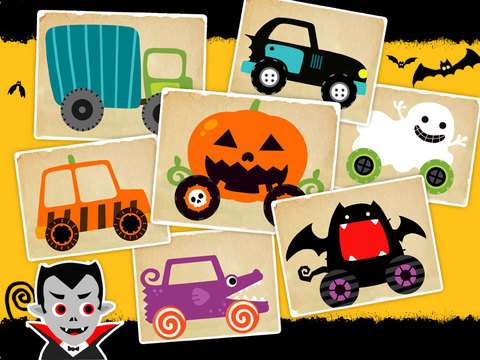 Labo Halloween Car-the kids I work with love the racing games so when I saw the Halloween Car app by Labo Lado, I had to have it. I've used it with a few of the kids I work with and they really are loving it. They get to choose from 12 different cars, several of them being Halloween themed (think bat, pumpkin and ghost). They get to color it any way they want, add wheels and then add details and a character to make their car their very own. Once they have completed designing it, they get to take it on a ride through different spooky racing routes.
This app is great for working on improving graphomotor skills, encouraging creativity and visual motor/perceptual skills. Also great for working on executive functioning skills, such as focus and attention and organizational skills.
 Stella and Sam Halloween Band-I've been a longtime fan of all things Stella and Sam by Zinc Roe Design since they are so interactive and work on so many occupational therapy goals. If you haven't checked out their other apps, do yourself a favor and do it! In this Halloween themed app, you get to join Stella and Sam in their band! There are 6 different instruments to play. You can change the sounds by moving the band members side to side or up and down. If you look carefully, you will see bats, spiders and other characters floating around that you can interact with. Great for preschoolers or young school-age children. You can work on color recognition by having the kids hit the different colors when you ask them to. As they get more familiar and comfortable with their colors, you can make this more complex by having them follow sequences. For some kids, you might want to make them remember the order just by telling them and for others you may want to put out a visual for them to follow. Kids will creating their own music while learning at the same time.
 Spooky Letters-I have a ton of great handwriting apps, but thought it would be fun to spice things up with this Halloween themed writing app by MadeByEducators. In this app, children can practice writing upper and lower case letters, cursive letters, shapes/pictures and words. What I really love about this particular handwriting app is that there is a big focus on phonics. After practicing writing each letter, the kids then have to put letters in order for a word that starts with that letter or put together a simple puzzle that reveals what monster is hiding in the box. For example, after you write the letter "K", a jumbled up word (key) comes up and they have to put them in order. During the whole thing, the kids are hearing the letters being sounded out which is great for those who are struggling with learning how to read.
**one thing I noticed is that some of the letters that we typically start at the top (M and N for example), actually start at the bottom. Could be confusing for some kids but there are a lot more positive things about this app that make it a good one to add to your handwriting app choices.
If you are concerned about using an iPad during therapy, keep in mind that there are a ton of ways to make it more therapeutic. I also can't Here are a few examples of things you can do to make using the iPad more meaningful, whether it be at home or during your therapy sessions:
*use a stylus-many of the apps can be done using a stylus. So even though the kids are absorbed in the app, they are working on developing a proper grasp.
*many of the kids I work with need to work on increasing their overall body strength, particularly upper body and neck/head. Have them go on the net swing and play the apps.
*if you work with groups of kids, almost any of these apps can be good for a small group setting. They will have to compromise about colors for their cars, what to feed the monster, take turns playing instruments, etc.. There are a lot of great social opportunities available when using the iPad in a therapeutic setting.
I would love to hear if any of you have some great Halloween or fall-themed apps that I should check out. I like to take advantage of holidays and mix things up during my sessions. Between the great arts and crafts activities, baking activities and the iPad apps, I have been rejuvenated the last couple of weeks during my sessions. The kids are also having a great time and excited for new things at the gym. So if you have any fun things to suggest to me or my readers, please share them! I am always a click away and love hearing from you all!
Thursday, 22 October 2015
Pro Evolution Soccer 2016
 | |
|---|---|
| Item Name | Pro Evolution Soccer 2016 |
| Price | Rp30.000 |
| System Reqruirement | |
| Available Stock | Ready |
| Trailer |
Subscribe to:
Posts (Atom)